
A Pulitzer Center: supported story produced by EMMA Radio & TV Media
About the Project
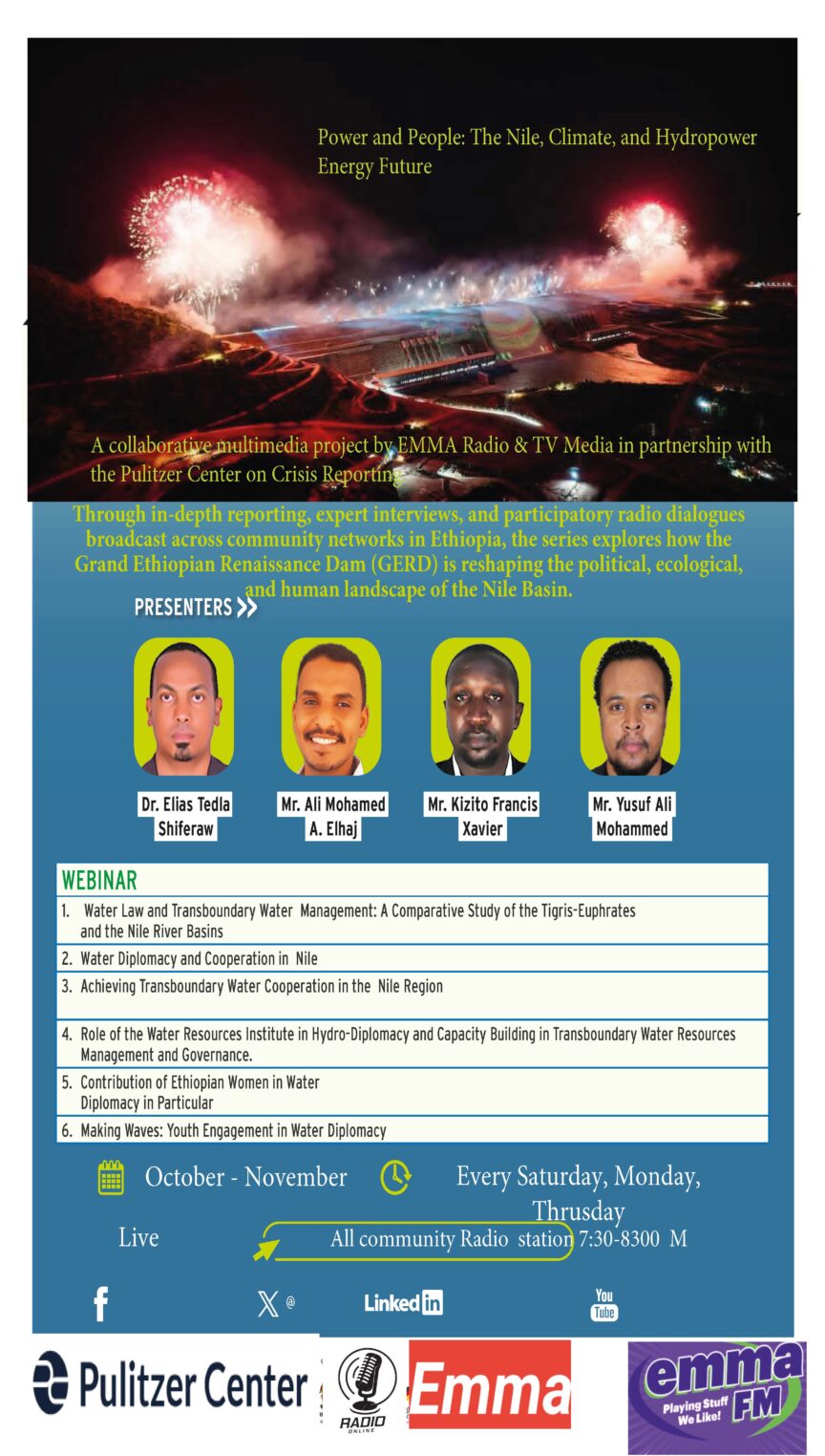
Power and People: The Nile, Climate, and Hydropower Energy Future is a collaborative multimedia project by EMMA Radio & TV Media in partnership with the Pulitzer Center on Crisis Reporting. Through in-depth reporting, expert interviews, and participatory radio dialogues broadcast across community networks in Ethiopia, the series explores how the Grand Ethiopian Renaissance Dam (GERD) is reshaping the political, ecological, and human landscape of the Nile Basin.
Combining field narratives with insights from transboundary water governance experts, including Dr. Osman Hamad, Dr. Modathir Zaroug, Dr. Elias Tedla, Dr. Yusuf Ali Mohammed, Eng. Ibrahim Dawelbeit and Dr. Ali Mohamed A. Elhaj, the story examines the delicate balance between energy ambition and regional cooperation. Inspired by Pulitzer Center grantee Ann Neumann’s acclaimed story “Hydropower,” the project reframes the Nile not as a line of division, but as a shared lifeline where water, climate, and human dignity converge.
A River, A Nation, A Promise
At dawn, the Nile is more than a river; it is a mirror of the human condition.
The mist rising from its waters carries whispers of kingdoms past, revolutions begun, and promises yet unfulfilled.
From the highlands of Ethiopia to the plains of Sudan and Egypt, the Nile has always been more than geography; it is a story of survival, sovereignty, and shared destiny.
But as the world warms and energy demand grows, this story has entered a new chapter, one defined by dams, diplomacy, and the desperate race to balance power with peace.
For Ethiopia, the Grand Ethiopian Renaissance Dam (GERD) is a national symbol of rebirth.
It stands as both a testament to engineering ambition and a lightning rod for regional tension.
“From the Ethiopian point of view, a modern dam is what will make their country a modern state,” wrote Ann Neumann in her Pulitzer Center story “Hydropower.”
The dam promises 6,500 megawatts of electricity, three times the output of the Hoover Dam, and a future where power no longer means darkness.
Yet the question remains: power for whom, and at what cost?
The River under Suspension flows
When EMMA Radio and TV Media, in collaboration with the Pulitzer Center, launched its participatory program Power and People: The Nile, Climate, and Hydropower Energy Future, it did so with a mission to spark public dialogue across Ethiopia’s airwaves and beyond.
Broadcast from Bahir Dar and shared through community radio networks nationwide, the series brought together hydrologists, policymakers, engineers, women leaders, and youth voices to unpack the human dimensions of hydropower.
In one episode, Dr. Osman Eltoum Hamad, a leading water governance scholar, described the Nile as a “living system that defies borders.”
“The river,” he said in the program, “doesn’t recognize nationality, only flow.
It teaches us that cooperation is not a choice but a condition of survival.”
It’s a point echoed in the Hydropower report, which framed the GERD as “a dam that roils democratic relations in the Horn of Africa,” blurring the line between development and diplomacy.
Trans-boundary Water Governance: A Legal and Moral Imperative
As the PROGRAM experts explained during EMMA’s webinar, the Nile Basin’s challenge isn’t merely engineering; it’s governance.
Treaties that once divided the river’s rights among colonial powers now bind modern nations in outdated frameworks.
Dr. Elias Tedla, speaking to the program, noted:
“Our agreements are still rooted in the 1929 and 1959 treaties, documents older than our independence.
We must build a legal architecture that reflects today’s realities: climate volatility, population growth, and the rights of all riparian states.”
The message resonated across the broadcasts, from Addis Ababa to Khartoum and Cairo.
Experts called for “a cooperative framework that sees water not as leverage but as legacy.”
In Neumann’s Hydropower narrative, that same tension between sovereignty and shared destiny runs through every paragraph:
“For nearly a century, Egypt prevented Ethiopia’s development of the river.
Ethiopians see the dam as a way to overcome poverty, a non-negotiable priority to capitalize on their own hydro resources.”
This friction, between historic grievance and future necessity, defines the politics of water in a century of climate uncertainty.
Energy for Whom?
Electricity, once a distant dream for rural Ethiopia, is now a rallying cry.
According to the World Bank, more than half of Ethiopians still live without access to reliable power, a statistic that Hydropower called “a haunting reminder that modernity remains unevenly lit.”
During EMMA’s broadcast, Eng. Ibrahim Dawelbeit underscored the moral dimension of hydropower:
“Energy justice means every drop and every water must serve people, not just policy.
Hydropower cannot shine if the villages near the dam remain in the dark.”
That sentiment rippled through the listener call: ins.
One caller from the Amhara region voiced what many feel:
“If our farmers see the river every day but can’t light a bulb at night, then what kind of progress is this?”
It is this human disconnect, between infrastructure and inclusion, that EMMA’s series sought to confront head-on.
The Blue Nile and the Politics of Trust
Few rivers carry as much symbolism as the Blue Nile, which begins at Lake Tana, considered sacred by many Ethiopians.
As Neumann wrote, “Lake Tana is sacred to Ethiopians, many of whom believe that the Ark of the Covenant was kept on its island of Tana Qirqos.”
This sacred geography adds emotional weight to a technical debate.
It’s not only a question of cubic meters and megawatts but of memory and meaning.
Dr. Modathir Zaroug, a transboundary water expert, told the EMMA team:
“The hydropolitical equation is changing fast.
Climate change will test every basin agreement we’ve ever signed.
The only way forward is to turn national plans into basin visions.”
From his perspective, the Nile Basin Initiative (NBI), the regional mechanism for cooperation, must evolve beyond policy meetings into a platform for shared climate adaptation.
In his words, “We need less suspicion and more science.”
Legal Pathways and Institutional Renewal
The PROGRAM panel called for strong institutional mechanisms to uphold shared accountability.
Dr. Yusuf Ali Mohammed emphasized that “water diplomacy must not be inherited like old grievances, it must be reimagined through science, solidarity, and shared survival.”
He added that “data transparency” and “joint monitoring” are critical to preventing mistrust, echoing what the Hydropower story described as “a century of missed opportunities for cooperation.”
Dr. Ali Mohamed A. Elhaj, an expert on river basin law, pushed this further:
“The Nile will survive climate change.
The question is, will our cooperation survive it too?”
His warning carries both a challenge and an invitation: that governance must evolve from reaction to resilience.
Women and the Energy Transition
Across Ethiopia, women are on the frontlines of the climate-energy nexus, leading local adaptation, solar microgrid initiatives, and household energy transformation.
EMMA’s broadcast included the voice of a women’s cooperative leader from Bahir Dar who said:
“We carry water, we cook with wood, and we know what scarcity feels like.
Energy access is not just about electricity, it’s about dignity.”
Her statement echoed the broader theme of Hydropower: that true renaissance is not measured in turbines, but in the lives illuminated by them.
Youth, Faith, and the Future of the Nile
A generation that grew up hearing about water wars now talks about “hydropeace.”
During EMMA’s community dialogue, a young environmental engineer declared:
“We are the generation of water peace, of innovation, not confrontation.”
This optimism mirrors the hope embedded in Hydropower’s closing lines, where refugees in Cairo dream of a better Ethiopia, one powered not by conflict but by creation.
From Addis Ababa’s universities to diaspora groups abroad, young Ethiopians see hydropower as a platform for identity and progress, if it’s managed with fairness.
Turning Power Into Peace
At the heart of EMMA Radio’s partnership with the Pulitzer Center lies a simple conviction:
that journalism can bridge divides, that storytelling can turn policy into participation.
As Neumann wrote, “The Renaissance in Grand Ethiopian Renaissance Dam does a lot of work; the country, and its new leadership, have placed all their bets on this particular future.”
EMMA’s project, however, reminds us that this future is shared, not owned.
From the scientists calculating river flow to the farmers waiting for light, the story of the Nile is one of interdependence.
“Peace, like power,” the narrator concluded in the broadcast, “must be delivered, not declared.”
Acknowledgment
This feature is part of Power and People: The Nile, Climate, and Hydropower Energy Future,
a collaborative production by EMMA Radio & TV Media and the Pulitzer Center on Crisis Reporting.
It draws upon expert insights from Dr. Osman Hamad, Dr. Modathir Zaroug, Dr. Elias Tedla, Dr. Yusuf Ali Mohammed, and Eng. Ibrahim Dawelbeit, and Dr. Ali Mohamed A. Elhaj,
and is inspired by Ann Neumann’s Pulitzer Center-supported story “Hydropower.”
Broadcast across community radio networks and online platforms,
The program amplifies citizen voices on climate, energy, and cooperation,
reminding us that the river is not a border, but a bridge.
#PowerAndPeople
#TheNileFuture
#NileVoices
#HydropowerDialogues
#WaterForAll
#PulitzerCenterProjects
#EMMARadio
#ClimateAndEnergyAfrica
#FrancescaEkondaho
#Afy Malungu
#AwotHaileslassie
#WaterDiplomacyAfrica
#LegalFrameworksForWater
#NileBasinInitiative
#SharedWatersSharedResponsibility
#ScienceForPolicy
#WaterSecurityAfrica
#RegionalIntegration
<strong>Power and People: Gender, Water, and the Nile’s Future</strong>
A joint program by EMMA Radio & TV Media and the Pulitzer Center on Crisis Reporting The Nile is not only a river, it is memory, identity, and negotiation.From Ethiopia’s highlands to Egypt’s delta, its waters sustain millions and stir nations.As Ethiopia’s Grand Renaissance Dam rises on the Blue Nile, the debate deepens: who truly […]