
By Meserete Abebe Abay, Health Correspondent
Published November 2, 2026
A Virus Outpacing History
One hundred and seventy-four days after the initial declaration of the current outbreak, the continent faces an invisible enemy moving faster than its systems of containment. Speaking to journalists from the Africa Centres for Disease Control and Prevention (Africa CDC) headquarters during a high-stakes weekly press briefing on November 5, 2026, senior health officials laid bare a grim reality: the ongoing Ebola Virus Disease (EVD) outbreak driven by the Bundibugyo virus lineage has officially become the largest recorded in the history of the Democratic Republic of the Congo (DRC), and is tracking at twice the velocity of the devastating 2014 West Africa epidemic.
Led by Dr. Wessam Mankoula, Continental Incident Management Support Team Lead for the Ebola Response, alongside Professor Yap Boum II, Head of Emergency Preparedness and Response, and moderated by Bonney Tunya, the briefing underscored a widening fault line in global health security. While countries like Kenya and Nigeria have demonstrated masterclasses in early detection and localized containment, the epicenter in eastern DRC is buckling under the weight of operational friction, severe funding shortfalls, community mistrust, and debilitating security corridors.
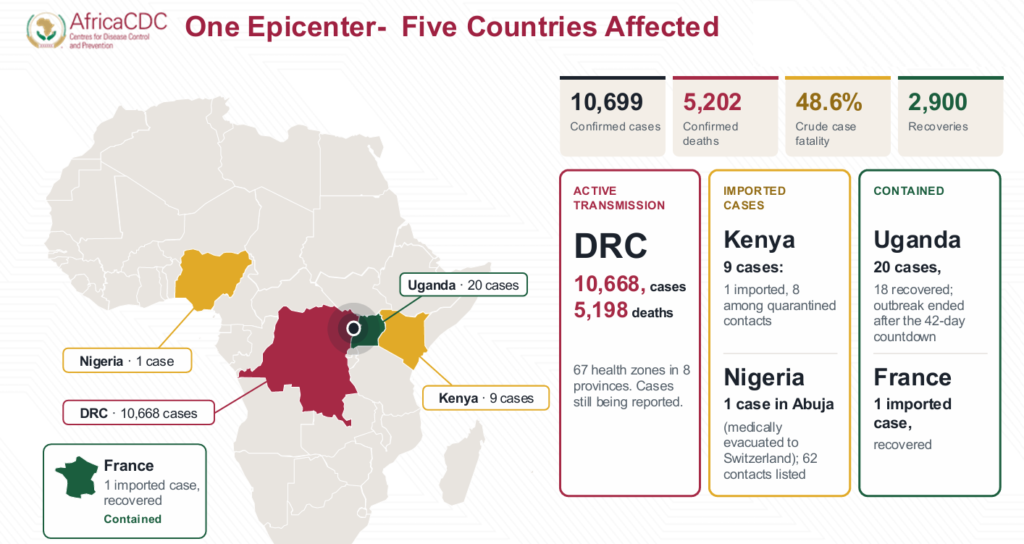
With cumulative continental figures reaching 10,699 cases and 5,202 deaths yielding a brutal crude case fatality rate (CFR) of 48.6%—the Africa CDC’s message was unequivocal: isolating transparent nations through sweeping travel bans will only sabotage global health surveillance, while failing to disburse promised international aid courts catastrophic regional collapse.
The Epicenter in Turmoil: Numbers That Demand Attention
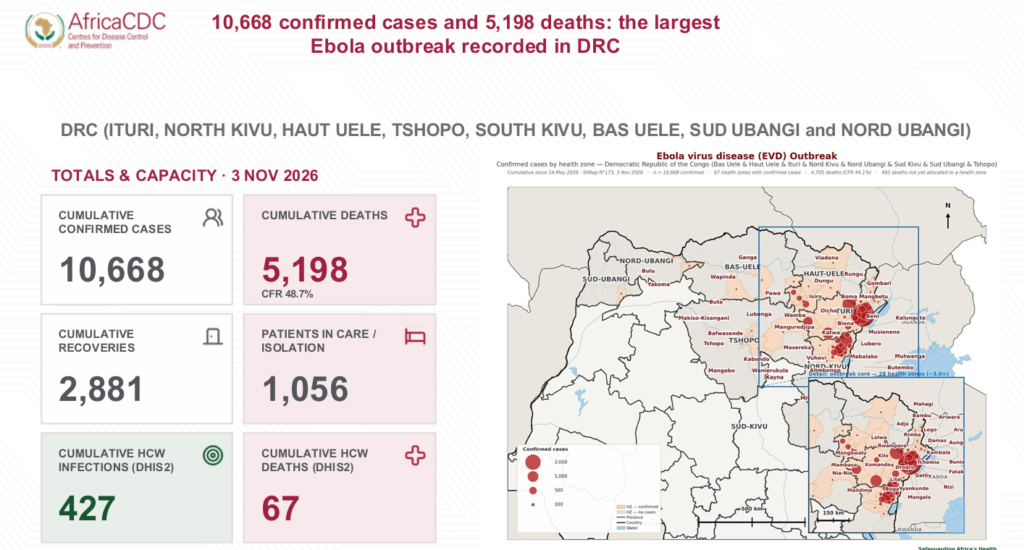
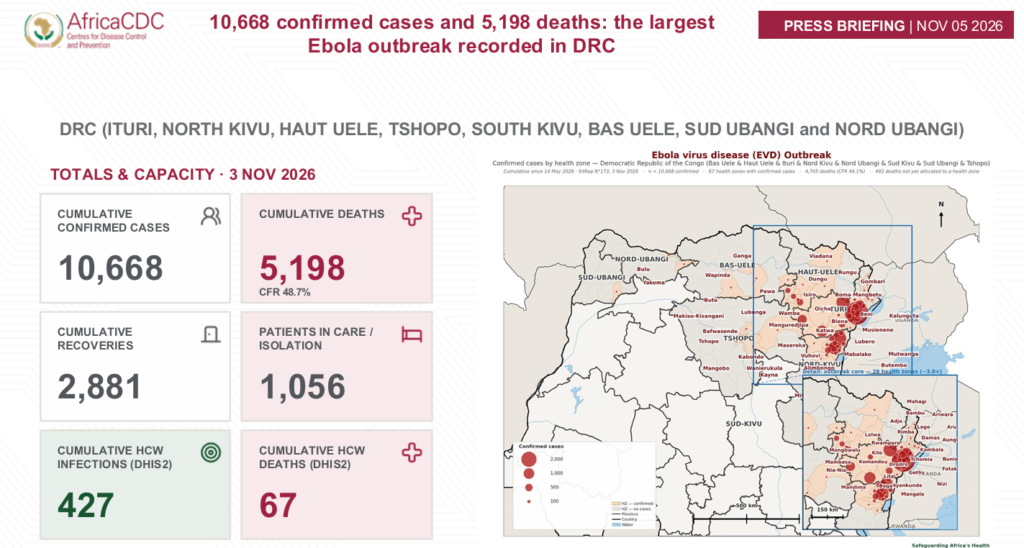
The core of the crisis remains firmly anchored in the DRC, where active transmission spans 67 health zones across 8 provinces. As of November 3, 2026, the DRC alone accounts for 10,668 cases and 5,198 confirmed deaths.
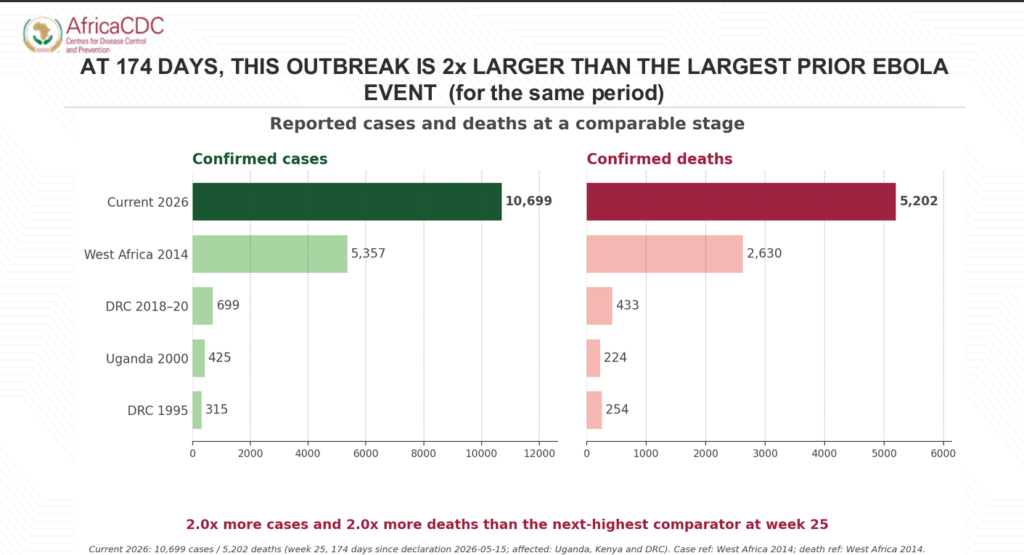
When juxtaposed against historical benchmarks, the sheer scale of the 2026 outbreak becomes staggering. At the 174-day mark, the current epidemic has generated two times more cases and two times more deaths than the West Africa outbreak of 2014 at the exact same comparative stage, and dwarfs previous DRC flare-ups, such as the 2018–2020 outbreak (which recorded 699 cases).
“As you can see from this graph, the current outbreak… in the first 174 days, we reported two more times the cases reported in the same duration when we’re comparing with West Africa,” Dr. Mankoula stated during his presentation. “And also, two more times number of deaths reported in similar duration.” Geographically, the burden is heavily concentrated. Ituri and North-Kivu alone account for 94.5% of all cases, with Ituri bearing 70.7% (7,213 cases) and North-Kivu representing 23.7% (2,419 cases). The top 20 health zones contribute over 90% of the total caseload. While regions like Mandima, Bunia, Nizi, and Katwa have shown tentative improvements, areas such as Beni, Mabalako, and Oicha are experiencing worrisome upward trajectories.
Compounding the clinical toll is the severe impact on frontline defenders. Cumulative healthcare worker (HCW) infections have reached 427, with 67 healthcare workers losing their lives in the line of duty in the DRC.
The Diagnostics of Failure: Contact Tracing Gaps and Community Deaths
Why is the virus maintaining a stubborn plateau averaging 400 to 500 new cases every week over a six-week stretch despite extensive interventions? According to Africa CDC data, the answer lies in systemic breakdowns in surveillance and community engagement.
- The Contact Tracing Deficit: During the 2018–2020 DRC outbreak, authorities listed approximately 57 contacts per confirmed case, accumulating roughly 190,000 contacts for 3,323 cases. In stark contrast, the 2026 outbreak with nearly 10,700 cases should theoretically have generated over 641,000 listed contacts. Instead, health teams have only managed to register 137,565 actual contacts just 21.4% of the historical benchmark. Consequently, more than 85% of new cases are emerging from outside known contact lists.
- The Community Death Crisis: An alarming 63% of all Ebola deaths continue to occur within the community rather than in specialized Ebola Treatment Centres (ETCs). Averaging across the weeks, this metric exposes deep-seated community mistrust, delayed care-seeking behavior, and severe gaps in safe burial logistics.
- The Known-Contact Yield: Only 11% of confirmed cases are currently linked to known, monitored contacts far below the target threshold of 95% required to decisively break transmission chains.
Regional Resilience: The Kenya and Nigeria Models
While the DRC struggles with active, widespread transmission, recent importations into Kenya and Nigeria have proven that swift, evidence-based public health interventions can successfully blunt the virus’s advance.
Kenya’s Containment Blueprint
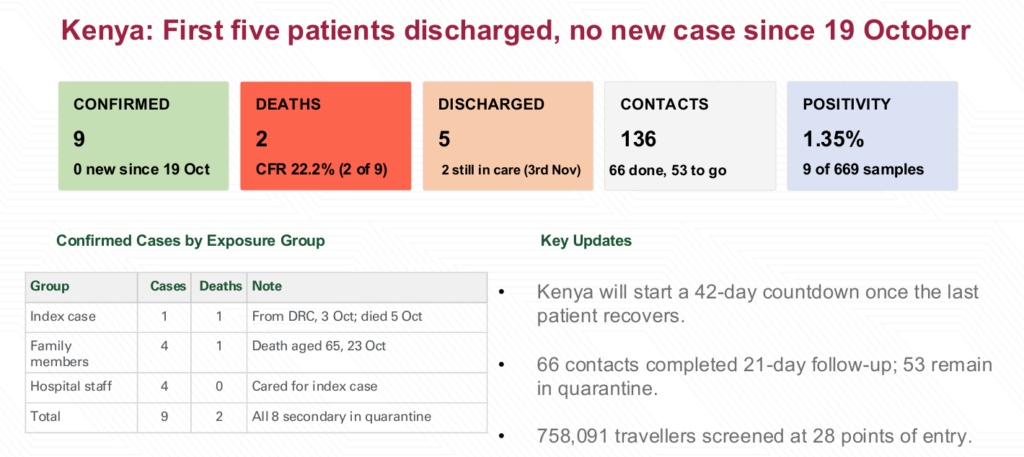
Kenya encountered its first imported case on October 3, 2026, which tragically resulted in the death of the index patient and her 65-year-old mother. However, through aggressive screening across 28 points of entry (screening over 758,000 travelers) and meticulous contact tracing, Kenyan authorities identified 136 close contacts.
Out of these, 8 secondary cases were confirmed all of whom were already isolated within quarantine facilities (comprising 4 family members and 4 healthcare workers who managed the initial case). Five patients have fully recovered and been discharged, leaving only two individuals receiving care as of early November.
“Kenia is giving a good model,” Dr. Mankoula emphasized. “How with one imported case you can move quickly to detect this case, identify all possible contacts, putting them under quarantine… This is how we see a good model that Kenya is presenting so far.”
Nigeria’s FCT Response
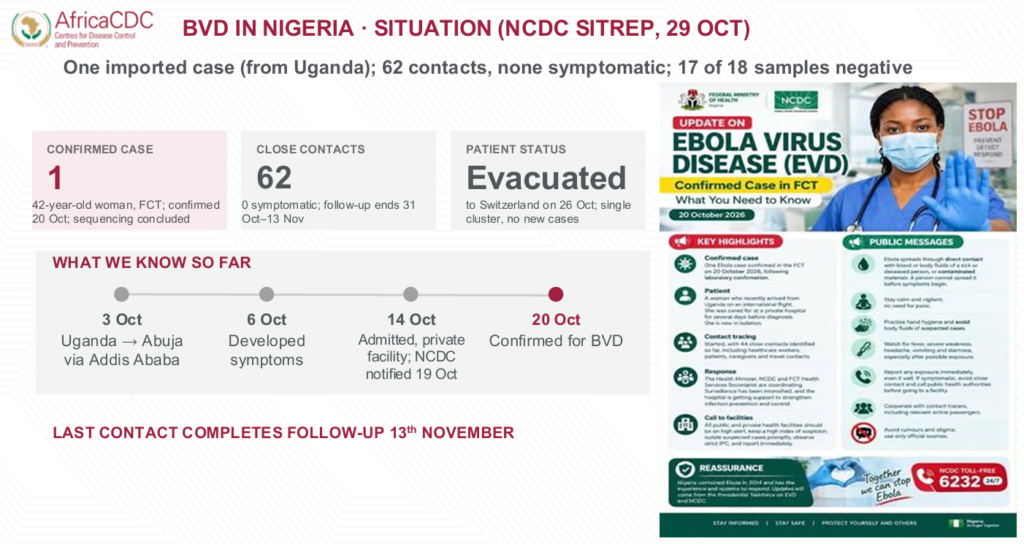
Nigeria recorded a single imported case in the Federal Capital Territory (FCT) involving a 42-year-old woman who traveled from Uganda via Addis Ababa on October 3. Symptom onset began on October 6, leading to multiple private healthcare facility visits before admission on October 14 and laboratory confirmation on October 20.
Acting on personal and governmental requests, the patient was medically evacuated to Switzerland on October 26 after showing clinical improvement. Nigerian health authorities successfully placed 62 close contacts under follow-up with zero secondary cases reported from the single cluster.
Geopolitical Friction: The Fight Against Unjustified Travel Bans
The success of Kenya’s transparent reporting has, paradoxically, exposed the country to punitive geopolitical measures. Following the detection of its cluster, Saudi Arabia and other nations imposed broad travel restrictions on passengers originating from Kenya.
The Africa CDC issued a blistering rebuke against these restrictions, aligning its stance strictly with World Health Organization (WHO) international health regulations.
“Let’s avoid these unnecessary travel restrictions,” Dr. Mankoula urged during the briefing. “We shouldn’t punish the countries for transparency… Countries that have invested in preparedness and readiness shouldn’t be punished for this. Let’s focus on isolating the virus, not isolating countries.” The agency called upon Saudi Arabia to immediately review and lift its broad restrictions, warning that penalizing transparent member states disincentivizes timely reporting and rewards opacity.
Scientific Innovation: Vaccines, Therapeutics, and Continental Preparedness
Amid operational hurdles, scientific and clinical trials are pushing forward across active zones in the DRC:
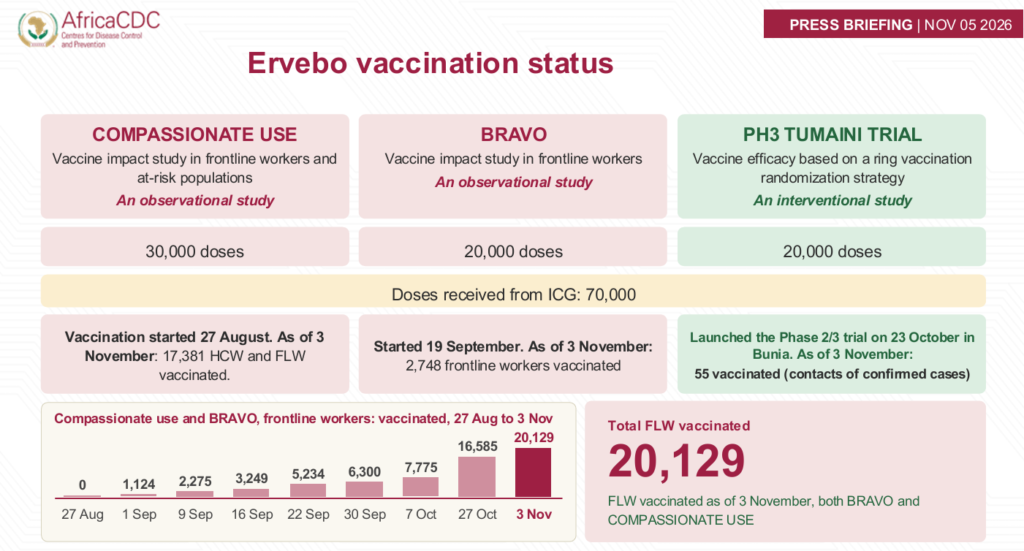
- Vaccination Milestones: Out of 70,000 doses secured via the International Coordinating Group (ICG), over 20,129 frontline workers and at-risk individuals have been vaccinated through compassionate use and the BRAVO observational study as of November 3. Furthermore, the Phase 2/3 interventional ring-vaccination trial—appropriately named Tomaini (Swahili for “hope”)—was successfully launched in Bunia on October 23, vaccinating 55 individuals by early November.
- Therapeutic Trials: The Partners Therapeutics trial (testing Remdesivir combined with monoclonal antibody MBP134) has enrolled 842 participants across four sites, pushing toward its target of 1,500 to 2,500. Simultaneously, the post-exposure prophylaxis trial testing Obeldesivir has reached 765 participants, achieving 77% of its target.
- The Preparedness Gap Across 31 Nations: A recent self-paced readiness survey conducted across 31 African member states in collaboration with the WHO revealed critical vulnerabilities. While rapid response teams and community awareness scored moderately high (71.6% and 69.0% respectively), three core pillars lag dangerously below the 50% threshold: Infection Prevention and Control (IPC at 44.1%), Case Management (46.7%), and Logistics (46.6%). Overall, only 3 countries demonstrated adequate readiness capacity, while 17 sit at moderate and 11 maintain strictly limited capacity.
As the briefing drew to a close, the Africa CDC issued a direct appeal to the international donor community. Of the $3 billion pledged toward the continental health emergency response, only about $1 billion has been disbursed to date.
For health systems stretching from the conflict-ridden hills of eastern DRC to the screening desks of Nairobi and Abuja, promises are no longer sufficient. Translating pledges into immediate financial disbursement, securing humanitarian corridors in security-compromised zones, and dismantling unjustified travel barriers remain the absolute preconditions for turning the tide against the largest Ebola crisis of the decade.
Source Material: Africa CDC Press Briefing Transcript and Official Presentation Slides (Nov 5, 2026).
በአማራ ክልል ሥርዓተ ፆታን ያካተተና ለሁሉም እኩል የትምህርት ዕድል የሚፈጥር ሥርዓት ለመገንባት የተቋማት ቅንጅት ወሳኝ መሆኑ ተጠቆመ
በ በውቀቱ ይደግ ህይወት ኢትዮጵያ የሥርዓተ ፆታ ተኮር የትምህርት ሥርዓት ግንባታና ምላሽ ሰጪ የትግበራ ሰነድን በተግባር ለማዋል ከመንግሥታዊና መንግሥታዊ ካልሆኑ አጋር ተቋማት ጋር የሁለት ቀናት ውይይት አካሄደ። በአማራ ክልል ሁሉም ሕፃናትና ወጣቶች ያለምንም የፆታ፣ የአካል ጉዳት፣ የማኅበራዊ ሁኔታና የኢኮኖሚ አቅም ልዩነት በእኩልነትና በደህንነት የመማር ዕድል እንዲያገኙ የትምህርት ሥርዓቱን ማጠናከር እንደሚያስፈልግ ተገለጸ። ህይወት ኢትዮጵያ ከህዳር 3 […]