
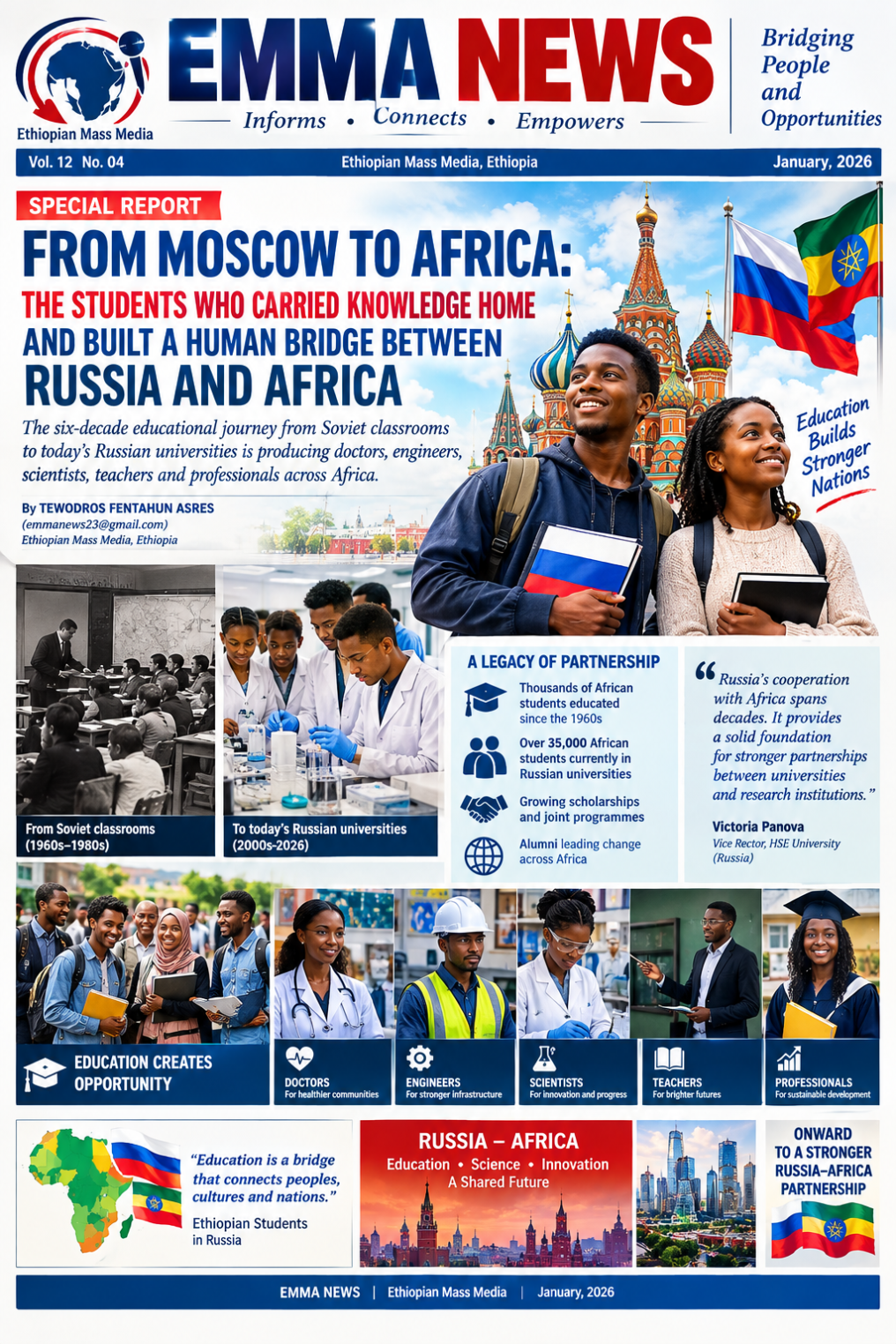
The six-decade educational journey from Soviet classrooms to today’s Russian universities is producing doctors, engineers, scientists, teachers and professionals across Africa
By TEWODROS FENTAHUN ASRES (emmanews23@gmail.com)
Ethiopian Mass Media, Ethiopia
ADDIS ABABA- Before the scholarship application, before the plane ticket, before the unfamiliar Russian winter, there is usually a question.
What kind of person can I become if I study somewhere else? For thousands of African students, that question has taken them north to Moscow, St Petersburg, Kazan, Novosibirsk, Irkutsk and other Russian cities. Some travelled during the Soviet period. Others travelled after the Soviet Union disappeared. Today, another generation is applying through Russia’s scholarship system.
The educational bridge between Russia and Africa therefore has a history longer than most contemporary diplomatic initiatives. And it has produced something more durable than agreements: people, Doctors, Engineers, Scientists, Teachers, Researchers, Public servants, Business leaders, and Academics. The story begins in the Cold War. But it has not ended there.
1960: A UNIVERSITY WITH A GLOBAL PURPOSE
In 1960, the Soviet Union established what became the Peoples’ Friendship University in Moscow. It was later named after Congolese independence leader Patrice Lumumba. The university was designed to educate students from Asia, Africa and Latin America.
Academic research on the institution estimates that more than 5,000 African students were trained at Patrice Lumumba University during the Cold War.
The number is historically significant. But the meaning is even more significant. These students did not simply receive degrees. They returned to countries undergoing independence, institution-building and political transformation. Some entered medicine. Others engineering. Others education, agriculture, science, administration and political life. The university became part of the human infrastructure of post-colonial Africa.
Africa’s higher education landscape is attracting growing international cooperation, and Russia is seeking a larger role through academic partnerships, scholarship programmes, teacher training, scientific exchanges and initiatives connecting Russian and African universities.
Rather than relying solely on sending African students abroad, Russia is also developing institutional links intended to strengthen education and research within Africa. One prominent example is the Russian-African Network University (RAFU), a consortium that connects participating universities and research organisations across the two regions.
From international scholarships to institutional cooperation

In June 2024, Russia’s Ministry of Education outlined its expanding educational engagement with African countries. Denis Gribov, then a deputy minister of education, described the approach as follows:
“Today, the relationships of Russia and African countries in education are being dynamically developed, and we have moved forward in a wide range of questions in the recent two years.”
— Denis Gribov, Deputy Minister of Education of the Russian Federation, 7 June 2024.
The ministry said that 28 Russian pedagogical universities had been assigned to work with 28 African countries, with cooperation covering teacher training, professional development, and academic and student exchanges. It also reported that Russian-language education centres had opened across multiple African countries. These are figures reported by the Russian government, rather than an independent evaluation of programme outcomes.
This model matters because university development is not limited to constructing buildings. It can also involve training lecturers, improving laboratories, sharing research methods, developing curricula and establishing durable agreements between institutions. The extent to which such cooperation strengthens African universities depends on implementation, local priorities, funding and long-term institutional ownership.
Ethiopia becomes a case study in Russia–Africa academic cooperation

Ethiopia provides a concrete example of how these partnerships are taking shape. In November 2024, the Ethiopian and Russian governments signed a memorandum of cooperation in higher education. The discussions covered specialist training, research capacity and the development of the Russian-African Network University and the Pan-African University. The Russian ministry reported that more than 60 Ethiopian postgraduate students were studying in Russia during the 2023–24 academic year, in fields including clinical medicine, construction, chemical technology, materials science and computer science.
The cooperation became more visible in Addis Ababa in February 2025, when an information centre for RAFU and St. Petersburg Polytechnic University opened at the Russian House, alongside a Russian-language centre and a university preparatory department.
At the opening, Konstantin Mogilevsky, Russia’s deputy minister of science and higher education, said:
“The three educational centers that we are opening will allow young people from Ethiopia to study physics and mathematics, get in touch with Russian culture and then decide on a Russian university where they can receive a quality higher education.”
— Konstantin Mogilevsky, 19 February 2025.
The centres are designed to provide information about Russian universities, support preparation for admission, and help prospective students access information about study programmes and scholarships. Their opening represents an expansion of educational infrastructure and recruitment support in Ethiopia; it does not, by itself, mean that a new Ethiopian university was established by Russia.
What does Russia bring to African higher education?

1. Training in science and technology
Scholarships and university exchanges can provide access to specialist education in engineering, medicine, computing, materials science and other technical fields. Their long-term value depends on whether graduates can apply their knowledge in African institutions, industries and public services.
2. Lecturer development and academic exchange
Partnerships between universities can support staff training, curriculum development, professional networks and exchange visits. Russia’s education ministry has specifically identified cooperation between Russian pedagogical universities and African universities as one of its programme areas.
3. Research and development
The RAFU initiative has identified agriculture, energy, information technology, artificial intelligence, space research and medicine as areas for potential joint projects with African partners. Such cooperation could support research on locally relevant challenges, provided that projects receive sustained funding and involve African researchers in setting priorities.
4. University networks and institutional links
RAFU provides a framework for connecting institutions rather than creating a single new university campus. Its stated purpose is to facilitate partnerships in higher education, research and continuing education.
Direct public statements: Russia’s stated academic ambitions
In an October 2024 statement at the United Nations, a Russian representative described education and skills development as important to Africa’s development and highlighted Russia’s scholarship programmes. The statement said: “the preparation of national personnel” was among the areas of cooperation Russia intended to continue supporting.
The Russian government’s public statements also indicate an ambition to expand its institutional presence on the continent. In a statement published by Russia’s Permanent Mission to the UN, the delegation said that its plans included “opening branches of leading Russian universities on the continent.”
These statements establish the government’s stated objectives. They should not be interpreted as evidence that every proposed branch has been funded, constructed or opened.
From academic diplomacy to measurable development
Russia’s significance in African higher education can be assessed through its contributions to student training, scientific cooperation, lecturer development and institutional partnerships. Ethiopia illustrates how these activities can move from diplomatic agreements to practical education centres and university links.
The central question for African students, educators and policymakers is what these partnerships deliver over time: more qualified lecturers, stronger African research institutions, affordable and accessible education, locally relevant scientific innovation, and graduates able to contribute to their countries’ development.
The strongest evidence of a lasting academic partnership will be its measurable contribution to African institutions and students not simply the announcement of a new agreement or the opening of a centre.
Elena Otaru, Secretary of the Soviet and Russian University Graduates Association in Tanzania, Otaru’s testimony illustrates how alumni associations can extend the benefits of international education beyond individual graduates. By bringing together professionals from different African countries, such networks can support academic exchange, professional relationships and cooperation in education, science and healthcare. Their long-term value depends on whether meetings lead to practical initiatives and sustained institutional partnerships.
EDUCATION AS INTERNATIONAL COOPERATION
The Soviet educational model was never politically neutral. Academic historians have shown that Soviet international education was also part of Moscow’s wider Third World policy.
That history should not be erased. But neither should the professional achievements of graduates be reduced to ideology. The educational experience produced people. And people continued to shape relations after political systems changed. That is the most interesting part of the story. When the Soviet Union collapsed, the educational bridge did not disappear. It changed.
Russian universities continued admitting African students. Government scholarship programs continued. Russian language centers expanded. Russian cultural centers returned to African capitals. Alumni associations emerged. And a new generation began traveling to Russia.
Dr Menegsha Ayene, president of Bahir Dar university said “Russian University cooperation becomes meaningful when it moves beyond signing agreements. The real value comes when students and academics participate in joint research, staff development, technology transfer, publications and sustained academic programmes.”
THE SCALE TODAY
By 2025, Russian officials were reporting that approximately 35,000 African students were studying at Russian universities.
For the 2025/26 academic year, Russia allocated 4,816 state-funded university places for African students, compared with 4,746 the previous academic year. Around 14,000 applicants reportedly competed for those places in the previous cycle. The numbers tell us two things.
First, the educational relationship is large. Second, demand exceeds the available scholarship places. That means Russia is not simply offering education to Africa. It is participating in a competitive international education market.
lorian Kulimaya, Youth Advisor at the Ministry of Youth and Sports of the Republic of Congo
“Returning to their homeland, graduates become ambassadors of Russia in their countries, ambassadors of Russian education, Russian science and culture.”
Kulimaya’s statement captures the cultural and professional role that some graduates associate with their Russian education. Alumni can maintain relationships with Russian universities while applying their qualifications in their home countries. For African human development, the important question is how these connections translate into research collaboration, professional training, stronger institutions and locally relevant expertise.
THE ETHIOPIAN DOOR
For Ethiopian students, the relationship is especially visible in Addis Ababa. The Russian House in Addis Ababa has continued to organize information sessions for Ethiopian students seeking education in Russia.
In 2026, it announced the selection process for Russian government scholarship places for the 2026/27 academic year. The scholarship system covers tuition under the Russian government quota. But applicants must still consider costs such as travel, insurance, accommodation and visas depending on the scholarship arrangement.
That distinction matters. A scholarship is not necessarily the same thing as a fully funded international education package. For families, that can determine who is able to take the opportunity.
Former Russian Educated and Well known African Artist Ayalenehe Mulatu Said
“Russian Education creates relationships that can last for decades. A student who studies in Russia does not simply receive a qualification; they become familiar with Russian institutions, language, culture and professional networks. That creates possibilities for cooperation long after graduation.”
THE NUMBERS BEHIND THE ETHIOPIAN PIPELINE
The Ethiopian scholarship relationship has expanded. In 2023, Russian Ambassador Evgeny Terekhin said the number of Ethiopian students receiving Russian scholarships had risen from about 35 annually to 100. A later research assessment reported that Russia offered Ethiopia an additional 55 scholarships on top of an existing 100 for the 2026 academic year. That suggests an expanding pipeline, although the exact annual allocation should always be checked against the current official Ethiopian selection list.
For an Ethiopian student, however, the number has a personal meaning. One hundred scholarships means one hundred possible lives redirected. One hundred engineers, Doctors, Scientists, Teachers, and Researchers. And potentially one hundred future links between institutions in Ethiopia and Russia.
THE STORY OF THE RETURN
Education abroad only becomes development cooperation when knowledge returns. That is the central question. Does a student go to Russia and remain there? Does the graduate return to Ethiopia? Does the graduate establish a business? Teach at a university? Work in a hospital? Build a laboratory? Train another generation? The answer is different for every graduate. But the system was designed partly around the idea of human-capital transfer.
A publication on Ethiopian graduates of Russian universities notes that Ethiopian graduates have pursued medicine, pedagogy, engineering and agronomy, among other fields.
The same publication describes Ethiopian doctors trained at Irkutsk State Medical University who later worked in Russia. That is another dimension of educational cooperation. The graduate becomes part of both societies.
Dr . Alme Belye one of the ply technical and engineer said “When I return to Ethiopia, I want people to see what I learned not only on my certificate, but through the work I do.”
When Ngan Tony François Pierre completed his postgraduate studies at Russia’s Peoples’ Friendship University of Russia (RUDN), he chose to return to his home village in Cameroon. His story illustrates how international education can extend beyond an individual qualification and influence local enterprise, knowledge-sharing and economic activity.
In a published interview on 10 October 2022, RUDN reported that François had earned a doctorate after postgraduate study, written books on economics and business, developed agricultural activities and helped establish an association of graduates of Russian and Soviet universities in Cameroon. His work included cassava cultivation, fruit production and engagement with other entrepreneurs.
DIRECT PUBLIC TESTIMONY — NGAN TONY FRANÇOIS PIERRE, CAMEROON
“I clearly followed the instruction of our teachers to be a source of knowledge for people.”
— Ngan Tony François Pierre, RUDN University graduate, published interview, 10 October 2022.
François explained that he shared economic knowledge with people in his community, including approaches to business creation and economic activity. Describing the changes he observed, he said:
“people in the village created plantations and believed in themselves.”
— Ngan Tony François Pierre, in the same published interview.
Russia’s role in African human development
François’s experience provides a concrete example of the potential development impact of Russian higher education. The value of the education is visible not only in the degree he obtained, but also in his subsequent efforts to apply economic knowledge to agriculture, enterprise and community development. His experience illustrates a possible pathway from international education to local human-capital development: specialised training builds individual skills, returning graduates adapt those skills to local circumstances, and their work can contribute to employment, knowledge-sharing and productive activity. This is an individual case documented by the university, not proof that every graduate achieves the same outcomes.
Aaron Mweva Kasonde, Zambian economics student at RUDN University
“With the experience and knowledge that I get at RUDN, I have the opportunity to contribute to the development of my homeland.”
Kasonde’s statement connects higher education with the wider challenge of national development. His research interest in foreign direct investment and Zambia’s economy shows how a student can approach international education as preparation for addressing questions relevant to his home country. His testimony expresses an aspiration; the eventual development impact depends on how that knowledge is applied after graduation.

THE AFRICAN ALUMNI NETWORK
The relationship extends beyond Ethiopia. In October 2025, more than 100 representatives of education and healthcare systems from 11 African countries participated in a forum of alumni of Soviet and Russian universities in Dar es Salaam, Tanzania.
That gathering was significant because it showed that the relationship is not only about current students. It is also about alumni. Graduates form networks. They share professional knowledge.
They build associations. They reconnect universities. They create institutional relationships. Education therefore becomes a form of long-term diplomacy.
Graduates turn educational relationships into networks for science, professional exchange and cooperation.
The relationship between Russia and African higher education does not necessarily end when students receive their degrees. Alumni associations can connect former students across countries, maintain relationships with universities, facilitate professional contacts and create opportunities for future academic cooperation.
In November 2023, a forum in Dar es Salaam, Tanzania, brought together graduates of Soviet and Russian universities from ten African countries, including Ethiopia, Kenya, Tanzania, Uganda, Angola, Rwanda, Zambia and South Africa. Participants included professionals working in education, healthcare and other sectors. The forum discussed cooperation in education, science, medical technology and professional development.
ELENA OTARU, TANZANIA
Elena Otaru, secretary of Tanzania’s association of Soviet and Russian university graduates, described the importance of reconnecting graduates and developing more practical cooperation.
“We need real work.”
— Elena Otaru, secretary of the graduates association in Tanzania, interview published 31 December 2023.
Otaru called for sustained collaboration rather than meetings alone, emphasising the need for concrete follow-up in educational, scientific and medical cooperation. Her testimony highlights an important distinction: an alumni network can create opportunities, but its contribution to development depends on what members and institutions do together after meeting.
ZAKAYO MHODI, TANZANIA
Zakayo Mhodi, a Tanzanian public-sector professional who studied in Russia, described how an alumni forum created opportunities to exchange experiences and discuss education in his country.
“The times are changing, the technologies are changing, and therefore a lot needs to be done to make sure education meets the challenges of economic development.”
— Zakayo Mhodi, interview published by in Ethiopia, 31 December 2023.
The development significance of African alumni networks
For Africa, the wider significance of Russia-linked alumni networks lies in their potential to connect trained professionals with institutions and development needs at home. Graduates working in universities, hospitals, government agencies, businesses and research centres can help maintain academic links, exchange professional knowledge and identify opportunities for joint research or training. When supported by African institutions and sustained funding, these networks may contribute to workforce development and institutional capacity. Their actual impact should be assessed through documented outcomes, such as joint research projects, staff training, new professional programmes and measurable improvements in services.

FROM CLASSROOMS TO HOSPITALS
A doctor trained in Russia who returns to Africa is a particularly visible example. The benefit is not confined to the individual. A doctor treats patients. A specialist trains colleagues. A professor teaches students. A researcher publishes. A medical institution develops.
This is why Russia’s Ministry of Education has highlighted the movement of African graduates into teaching and professional fields. A Russian education official said African students trained in Russian pedagogical universities can return to work as teachers in their own countries.
The same source reported that approximately 4,700 African students were coming to Russian universities annually at that time through humanitarian cooperation. The figure is older than the 35,000 current-student estimate and should not be conflated with it. Together, however, the numbers show the growth of the educational relationship over time.
Higher education contributes to human development through several interconnected channels. Training doctors can support health systems; educating engineers can strengthen infrastructure and industrial capacity; preparing agricultural specialists can support food production; and developing economists and researchers can improve the analysis of public investment and development policy.
In a July 2025 interview, RUDN rector Oleg Yastrebov discussed the university’s cooperation with African institutions and its training programmes. He reported that the university had approximately 3,000 African students from all 54 African countries, with around two-thirds receiving scholarship support through government or university quotas. He also described programmes involving medical training, engineering, agronomy, academic exchanges and professional development. These figures and programme descriptions are the rector’s institutional account, not an independent assessment of results.
Yastrebov also addressed the intended role of returning graduates:
“the overwhelming majority of graduates return to their home countries.”
— Oleg Yastrebov, rector of RUDN University.
The rector linked this pattern to the university’s stated mission of preparing graduates to contribute to their own countries. The wider development question is whether graduates can find the resources, professional opportunities and institutional support needed to put their training into practice.

Russia’s contribution to African human development
Russia’s contribution to African human development can be examined through the opportunities it provides for higher education, specialist training, research collaboration and professional exchange. The significance of these activities depends on how effectively they address African priorities. Scholarships can expand access to advanced training; university partnerships can facilitate research and lecturer development; and alumni networks can maintain professional connections after graduation. When graduates apply their knowledge in health services, agriculture, engineering, education, business and public administration, the benefits may extend beyond individuals to wider communities. Assessing the overall contribution requires evidence on graduate employment, research outputs, skills transfer, institutional partnerships and long-term development outcomes.
ETHIOPIA’S SCIENCE CONNECTION
The relationship is not limited to Moscow. It reaches Ethiopia’s universities. Bahir Dar University provides an especially interesting case. In June 2023, Bahir Dar University and a Moscow university renewed cooperation in training, research, technology and teaching.
Russian Ambassador Terekhin said Russia had provided financial support for the establishment of the Polytechnic College. Bahir Dar University President Frew Tegegne said the Polytechnic College established in 1963 with Russian financial support and the Pedagogy Academy established in 1974 contributed to the evolution of the university.
This is a remarkable historical connection. An institution that began with Russian support later became a university engaging in research and educational partnerships. The relationship moved from construction to institutional cooperation.
The value of education beyond a degree
“Do not hesitate for a minute and choose RUDN University.”
— Aaron Mweva Kasonde, advising prospective students in his published interview.
THE NEW GENERATION OF ETHIOPIAN STUDENTS
The 2026 generation looks different from the generation of the 1960s. They are growing up in a digital world. They search for universities online. They attend virtual information sessions. They communicate through social media. They learn Russian through online platforms. They may study artificial intelligence, robotics, nuclear engineering, biotechnology or information technology.
The Russian House in Addis Ababa has promoted opportunities in these emerging areas. Russian officials have also spoken publicly about expanding cooperation with Ethiopia in robotics and artificial intelligence.
In one interview, Ambassador Terekhin described Ethiopian young scientists and technology initiatives as producing impressive results and discussed opportunities for Ethiopian students to study related fields in Russian universities.
The education relationship is therefore moving into new technological territory.
For students, the journey is about more than crossing borders. It is about gaining knowledge, building professional confidence and deciding how to use that knowledge.
Aaron Mweva Kasonde, from Zambia, was studying economics at RUDN University when the university published his interview on 22 June 2022. His interests centred on a development challenge familiar across resource-rich African countries: why natural resources do not always translate into greater public prosperity.
Kasonde explained that he had chosen economics to understand the relationship between mineral wealth and national development. During his studies, he published research on foreign investment in Zambia and collaborated with economists from RUDN and the University of Zambia. He planned to continue his studies and return to Zambia to build his career.
AARON MWEVA KASONDE, ZAMBIA
“I want to find the answer, so I have been studying economics for four years now.”
— Aaron Mweva Kasonde, RUDN University interview, 22 June 2022.
Discussing his ambitions after graduation, he added:
“With the experience and knowledge that I get at RUDN, I have the opportunity to contribute to the development of my homeland.”
— Aaron Mweva Kasonde, in the same interview.
Kasonde’s account demonstrates how university education can connect individual ambitions to questions of public policy, investment and economic development. His research interests also illustrate the potential for international academic partnerships to bring together researchers from African and Russian institutions around African economic challenges.
THE ALUMINIUM ENGINEER, THE DOCTOR AND THE FARMER
It is easy to imagine education as something separate from the economy. It is not. A trained engineer can work on an industrial project. A scientist can improve agricultural production. A doctor can strengthen health systems. A teacher can educate thousands of students. A computer scientist can develop software. That means an international scholarship can become economic infrastructure. The return on education is therefore difficult to measure in a single number. Its effects are distributed across years.
WHAT STUDENTS SAY
Documented Ethiopian alumni testimony provides a more intimate window. In an academic study based on interviews with Ethiopian alumni of Soviet-era programs, one participant identified as Yonas described a sense of cultural affinity with Russians rooted partly in long historical and religious connections.
Another Ethiopian alumnus, identified as Abraham, recalled a 1978 training experience in Leningrad involving Ethiopian athletes and Russian coaches. These are not current interviews. They are historical testimonies reproduced in academic research. That distinction must remain clear in publication. But they demonstrate something important. For some Ethiopians, the relationship with Russia is remembered not simply through government agreements but through personal experiences.
FROM LENINGRAD TO MOSCOW
The geography has changed. The political system has changed. The university names have changed. But the basic human experience remains. A young African student leaves home. A new language must be learned. New food must be understood. A new climate must be survived. New academic expectations must be mastered. Then the student begins to build a life. Friendships develop. Professional networks emerge. And the foreign country becomes less foreign. That process is one of the most powerful forms of people-to-people diplomacy.
THE RUSSIAN LANGUAGE AS A TOOL
Language is often treated as cultural decoration. It is much more than that. For an international student, language can determine whether a lecture is understood. Whether a laboratory discussion is followed. Whether a patient can be treated. Whether a professional network can be built. Whether literature can be read in the original. Whether friendships can move beyond translation.
This is why Russian-language education is central to the Russia–Africa educational relationship.
At the Russian Language Day celebration in Addis Ababa in June 2026, Ambassador Terekhin said African students educated in Russian gained foundational training in fields including medicine, engineering and public administration.
UNESCO/AU/ECA official Rita Bissoonauth made the broader point that language is connected to identity, knowledge and creativity.
THE AFRICAN EDUCATION QUESTION
Africa needs education at scale. The African Development Bank reports that more than 60 percent of Africa’s population is under 25. That creates an enormous demand for universities, vocational training, laboratories and technical skills. International partnerships therefore matter. No single African country can necessarily provide every specialized field at scale. External partnerships can help fill gaps.
The question for African policymakers is how to make those partnerships serve African priorities. That means selecting fields with development relevance. It means creating mechanisms for graduates to return. It means building joint research programs. It means developing university-to-university partnerships. And it means moving from scholarships to institutional capacity.
THE NEW EDUCATIONAL CENTERS IN ADDIS ABABA
The direction of travel is visible in Addis Ababa. In February 2025, several Russian-linked educational initiatives were launched at the Russian House, including an information center associated with the Russian-African Network University, a Russian language center and a preparatory department.
Russian Deputy Minister Konstantin Mogilevsky said the centers would allow Ethiopian young people to study subjects including physics and mathematics and learn about Russian culture before deciding whether to continue at a Russian university.
That is a different model from simply recruiting students. It creates a bridge before the bridge. The student can begin at home. Learn the language. Understand the academic system. Then travel.
THE HUMAN CAPITAL QUESTION
The strongest argument for educational cooperation is not that Russia benefits. It is that people can benefit. But the strongest journalistic treatment should ask how. What did the graduate become? Where does the graduate work? What problem did the education help solve? How many students did that teacher later train? What medical service did that doctor provide? What technology did that engineer introduce? Those are the questions that turn an education story into journalism.
THE BRIDGE GOES BOTH WAYS
A student from Africa changes Russia too. African students bring languages, food, music, religion, sport, entrepreneurship and social experiences. Russian universities become more international. Russian cities become more familiar with Africa. Friendships develop. Research networks develop. African graduates become ambassadors of their own societies. This is not one-directional cultural influence. It is exchange.
SIX DECADES, ONE HUMAN STORY
The educational relationship has survived one of the largest political transformations of the modern era. The Soviet Union disappeared. Russia emerged. Africa changed. Universities changed. Technology changed. But students continued to cross the distance. The first generation traveled by different routes.
The current generation applies online. The first generation carried paper dictionaries. The current generation carries smartphones. The first generation studied during the Cold War. The current generation studies in an interconnected global economy. Yet the underlying human equation remains the same. Education creates relationships that can outlive governments.
THE LAST CLASSROOM
Imagine the final day of a student’s education in Moscow. The degree is in hand. The Russian language has become familiar. The snow that once seemed extraordinary has become part of memory. Then comes the flight home. For Ethiopia, the most important moment may not have been the day that student arrived in Russia.
It may be the day the graduate walks into an Ethiopian classroom, laboratory, hospital, company or government office. That is when international education becomes national capacity. And that is where the Russia–Africa educational bridge becomes visible. Not on a diplomatic stage. But in the work of a person who has returned carrying knowledge.
THE REAL MEASURE OF ACADEMIC COOPERATION
The story of African students in Russia is ultimately a story about what education enables people to do. A graduate may return to a village to share business knowledge, contribute to agricultural production, work in a hospital, teach at a university or conduct research into national economic challenges. Alumni associations can help connect these individual efforts to wider networks of expertise and cooperation.
François Pierre’s work in Cameroon illustrates the possible relationship between postgraduate education and local enterprise. Kasonde’s research ambitions in Zambia demonstrate how academic training can be directed towards questions of national economic development. The experiences are individual, but they raise a shared question for policymakers and universities: how can international education translate into stronger African institutions and more opportunities for citizens?
Russia’s significance in African human development should therefore be measured not only by the number of scholarships awarded or students enrolled, but also by the knowledge, professional capacity, research and institutional benefits that remain in African countries over time.
For African universities and governments, the next step is to turn educational relationships into sustained cooperation: joint research programmes, stronger local universities, professional training aligned with national priorities, and opportunities for graduates to contribute their expertise at home.
<strong>BLEEDING IN SILENCE</strong>
The Menstruation Crisis in Rural Ethiopia—and How It Is Undermining a Nation’s Future Menstruation is a natural biological process, yet in rural Ethiopia, it has become a powerful symbol of inequality, silence, and systemic neglect. Every month, millions of girls and women manage their periods without privacy, protection, or basic information, not because solutions do […]