
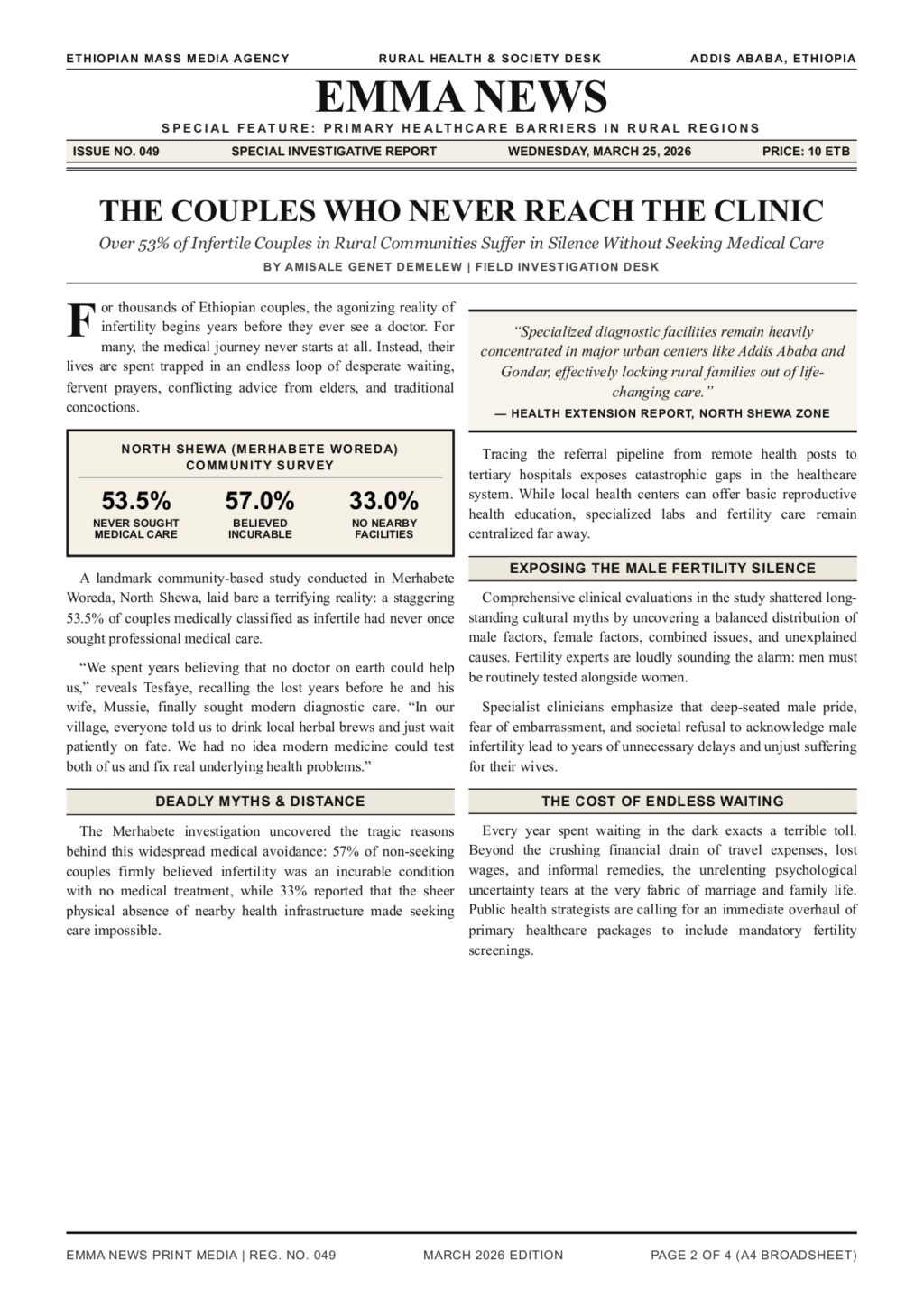
By Amisale Genet Demelew
EMMA NEWS – Ethiopian Mass Media
Publication No. 049 | Date: March 25, 2026
For thousands of Ethiopian couples, the agonizing reality of infertility begins years before they ever see a doctor. For many, the medical journey never starts at all. Instead, their lives are spent trapped in an endless loop of desperate waiting, fervent prayers, conflicting advice from elder relatives, risky traditional concoctions, and delayed action holding onto the fragile hope that the next month will miraculously end their heartbreak.
A shocking community-based study conducted in Merhabete Woreda, North Shewa, laid bare a terrifying reality: a staggering 53.5% of couples medically classified as infertile had never once sought professional medical care.
“We spent years believing that no doctor on earth could help us,” reveals Tesfaye, his voice heavy with regret as he recalls the lost years before he and his wife, Mussie, finally sought modern diagnostic care. “In our village, everyone told us to drink local herbal brews and just wait patiently on fate. We were completely in the dark—we had no idea that modern medicine could test both of us and fix real underlying health problems.”
The deadly myth that nothing can be done
The groundbreaking Merhabete investigation uncovered the tragic reasons behind this widespread medical avoidance. Among the couples who suffered without seeking professional help, an overwhelming 57% stated they firmly believed infertility was an incurable condition with no medical treatment, while 33% reported that the sheer physical absence of nearby health infrastructure made seeking care impossible. These deep structural barriers are made far worse by harsh cultural taboos and crippling poverty.
The treacherous road to specialized care
Tracing the referral pipeline from remote, rural health posts to major regional referral centers exposes catastrophic gaps in the health system. Health extension workers on the frontlines report that while local health centers can offer basic education, specialized diagnostic laboratories and fertility treatments remain concentrated in distant urban centers like Addis Ababa and Gondar effectively locking impoverished rural families out of life-changing care.
Exposing the male fertility silence
The comprehensive clinical evaluations in the Merhabete study shattered long-standing cultural myths by uncovering a balanced distribution of male factors, female factors, combined issues, and unexplained causes. Fertility experts are loudly sounding the alarm: men must be routinely tested alongside women. Specialist clinicians emphasize that deep-seated male pride, fear of embarrassment, and societal refusal to acknowledge male infertility lead to years of unnecessary delays and unjust suffering for their wives.
The destructive cost of endless waiting
Every year spent waiting in the dark exacts a terrible toll. Beyond the crushing financial drain of travel expenses, lost daily wages, and expensive informal remedies, the unrelenting psychological uncertainty tears at the very fabric of marriage and family life.
Breaking the cycle of silence
Public health strategists are calling for an immediate overhaul of primary healthcare: integrating mandatory fertility screenings into routine community health packages and launching aggressive educational campaigns to dismantle destructive superstitions. The absolute first step in saving these couples is ensuring every family knows that medical hope exists and that treatment is within reach.

<strong>From River to Voice: How Youth Across the Nile Basin Are Rewriting the Story of Hydropower</strong>
By EMMA RADIO AND TV MEDIA Team In a region long defined by tension, treaties, and towering infrastructure, a quieter but potentially more transformative force is emerging: youth voices. From February to March 2026, a hybrid civic engagement initiative centered in Addis Ababa brought together students, journalists, researchers, and digital creators from across the Nile […]