
By EMMA RADIO AND TV MEDIA Team
In a region long defined by tension, treaties, and towering infrastructure, a quieter but potentially more transformative force is emerging: youth voices.
From February to March 2026, a hybrid civic engagement initiative centered in Addis Ababa brought together students, journalists, researchers, and digital creators from across the Nile Basin to rethink one of Africa’s most contested issues: hydropower and the future of the Nile. What began as a modest outreach project evolved into a multi-layered platform for dialogue, creativity, and knowledge production, reaching more than 500,000 people across the region.
At the heart of the initiative was a powerful piece of journalism by Ann Neumann, published through the Pulitzer Center on Crisis Reporting. Her reporting on hydropower and the Nile Basin challenged dominant narratives and provided a foundation for a new kind of public engagement; one that placed human stories, rather than political slogans, at the center.
“From River to Voice: How Youth, Journalism, and Digital Storytelling Reimagined the Politics of the Nile”
Inside the extraordinary journey of a hybrid civic engagement project that transformed hydropower from a national symbol into a shared regional conversation
In a region where rivers carry not only water but history, power, and tension, a bold experiment unfoldedone that dared to reimagine how young people engage with one of Africa’s most contested resources: the Nile.
Between December 2025 and March 2026, in Addis Ababa and across digital platforms connecting the Nile Basin, a project titled “Hydropower and Youth Voices: Ethiopia’s Water Future” quietly evolved into something far greater than a webinar series or youth contest. It became a living laboratory of knowledge production, dialogue, and transformation.
At its core was a powerful journalistic foundation: the hydropower reporting by Ann Neumann, whose work for the Pulitzer Center on Crisis Reporting challenged readers to see beyond infrastructure and into the human consequences of water politics.
But what followed was not just engagement; it was a movement of reinterpretation, resistance, and reimagination.
A Story That Sparked a Movement
For many Ethiopian participants, hydropower, especially in relation to the Grand Ethiopian Renaissance Dam, has long symbolized progress, sovereignty, and national pride. But Neumann’s reporting offered a more complex picture.
By documenting the lived experiences of refugees, the environmental implications of large-scale dams, and the geopolitical tensions surrounding the Nile, the story disrupted simplified narratives and invited deeper reflection.
“The story changed how I see the Nile,” one participant said during the in-person workshop. “It made me realize that water is not just about development; it’s about people, politics, and responsibility.”
This shift, from certainty to inquiry, became the foundation of the entire project.
I. The Beginning: When Journalism Became a Catalyst
The project began with a simple but radical premise: What if journalism was not the end of a story but the beginning of a conversation?
Neumann’s reporting had already disrupted dominant narratives. Her work exposed:
- The lived realities of refugees
- The contradictions of development
- The political fragility surrounding the Nile
For many Ethiopian youth, hydropower, especially the Grand Ethiopian Renaissance Dam, had long symbolized pride, sovereignty, and progress. But the story complicated that narrative.
As one workshop participant reflected:
“Before this, I saw the Nile only through one lens—development. But the story showed me people, struggles, and voices I had never considered.”
This shift from certainty to questioning became the intellectual spark of the project.
Webinars as a Cross-Border Classroom
The initiative’s three-part webinar series brought together experts from Ethiopia, Sudan, Egypt, Kenya, Uganda, and Rwanda. Conducted online and streamed through multiple platforms, the sessions created a rare space for regional dialogue, one that transcended national boundaries.
Media scholar Negesse Belay emphasized the power of narratives in shaping public perception.
“The Nile is not only a natural resource; it is a story,” he said. “And the way that story is told determines how people understand conflict, cooperation, and development.”
His perspective resonated strongly with participants, particularly young journalists and digital creators, who began to see themselves not just as consumers of information but as producers of narratives.
Environmental and policy experts added further layers to the discussion, addressing climate change, sustainability, and the long-term implications of hydropower development. The message was clear: the future of the Nile cannot be understood through a single lens.
From Discussion to Dialogue
While the webinars provided intellectual depth, the in-person workshop in Addis Ababa offered something different: emotional engagement.
Sixty young participants gathered for a half-day dialogue session that began with a presentation of Neumann’s reporting. As excerpts were shared—particularly those highlighting refugee experiences and regional inequalities—the atmosphere shifted.
Participants moved from listening to questioning, from agreement to debate.
“We celebrate development,” one attendee noted, “but we rarely ask who is affected and how.”
Discussions ranged from the ethics of large-scale infrastructure to the role of media in shaping public opinion. For many, it was the first time they had engaged in such open and critical dialogue on the issue.
Creative Voices Take the Lead
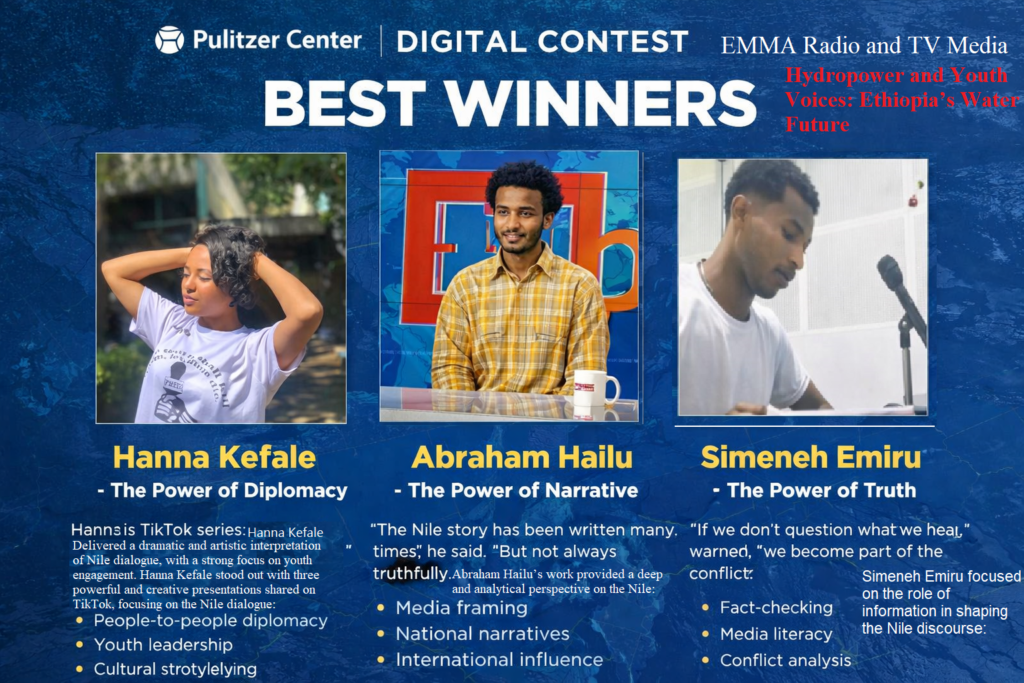
The project’s digital contest transformed these conversations into creative expression. With more than 180 submissions from across the Nile Basin, the contest became a showcase of youth perspectives—diverse, critical, and deeply engaged.
Among the standout contributors was Hanna Kefale, whose series of short videos explored the role of diplomacy and youth engagement in shaping the future of the Nile.
Her work emphasized that while infrastructure projects like dams are important, sustainable solutions require cooperation and dialogue among people.
Second-place winner, Abraham Hailu focused on media narratives, examining how historical and contemporary storytelling has influenced perceptions of the Nile.
“The Nile story has been shaped by many voices,” he said. “But not all of them reflect the full reality.”
Meanwhile, Simeneh Emiru tackled the issue of misinformation, highlighting how competing narratives can fuel misunderstanding and conflict.
Together, these works demonstrated the power of creative media to engage with complex issues in accessible and impactful ways.
A New Model of Engagement
Beyond its immediate outputs—webinars, workshops, and digital content—the project introduced a new model for civic engagement.
By combining journalism, dialogue, and creativity, it created a multi-layered approach that moved participants from passive learning to active participation.
Survey results reflected this transformation:
- 85% of participants reported improved understanding of hydropower and regional issues
- 78% felt more engaged in discussions about the Nile
- 90% valued journalism-based learning as a tool for civic education
More than 300 individuals actively participated through comments, submissions, and discussions, indicating a high level of engagement.
Challenges and Lessons
The project was not without its challenges. Coordinating participants and speakers across multiple countries required careful planning, while navigating sensitive political narratives demanded a balanced and inclusive approach.
Yet these challenges also reinforced the project’s central lesson: dialogue is both difficult and essential.
“Trust is not built in silence,” one organizer noted. “It is built through conversation—even when that conversation is uncomfortable.”
Looking Ahead
As water scarcity, climate change, and population growth continue to intensify pressures on shared resources, initiatives like this one offer valuable insights into how future challenges might be addressed.
By empowering young people to engage critically, think creatively, and communicate effectively, the project has laid the groundwork for a more inclusive and informed dialogue on the Nile.
More importantly, it has demonstrated that journalism, when combined with participatory platforms, can move beyond reporting to become a catalyst for change.
The Power of a Story
In the end, the success of “Hydropower and Youth Voices: Ethiopia’s Water Future” lies not only in its reach or outputs, but in its ability to transform perspectives.
What began as a story about hydropower became a conversation about identity, responsibility, and the future.
And in that transformation lies its greatest achievement.
As one participant put it:
“The Nile is no longer just a river to me. It is a shared story and we all have a role in writing its next chapter.”
For media inquiries or access to project materials, recordings, and research outputs, please contact EMMA Radio and TV Media PLC. emmanews23@gmail.com
<strong>“From River to Voice: How Youth, Journalism, and Digital Storytelling Reimagined the Politics of the Nile”</strong>
From contested waters to collective voices inside a groundbreaking youth-driven experiment reshaping the future of hydropower narratives in Africa In the politics of the Nile, the loudest voices have long belonged to states, engineers, and diplomats. But in early 2026, something unusual began to surface, quieter at first, yet far more disruptive: the voices of […]