
Addis Ababa, Ethiopia— April 25, 2025, EMMA NEWS; Investigative Climate and Conflict News Analysis by Ayele Addis Ambelu
“We used to predict the rains by the moon. Now, even the moon is silent,” says Halima, a pastoralist from Garissa, Kenya. In Mogadishu, displaced youth cite conflict over wells as their biggest fear. In Ethiopia’s Somali region, elders speak of lost grazing routes and new border tensions.
Halima
The Earth chips and cracks. Rivers vanish. Wells get dry, and in the broiling Horn of Africa, no longer is rainfall interrupted by the silence, but only by the crash of firearms. Ethiopia, Kenya, and Somalia are now amid a cataclysmic convergence of conflict and climate chaos. But still, there is also a disruptive instrument that can be seen in the eye of this slow-moving storm, and it is the Climate Conflict Vulnerability Index (CCVI). Its algorithms and quarterly data sets aside, there is a thrash of time: can we move faster than the vortex of climate-caused violence?
It is not a weather story. This is a message of the first line of the most explosive and hectic on our planet, where the power of nature collides against the vulnerability of human organization. In this investigation news, we bite into the statistics, the professional classes, the voices of marginalised people, and the extreme choices facing the governments and international organisations. We use 17 of the most accomplished field leaders, validation workshops, community case studies, and national and international reflections, combining the rigor of data with the context of the story in order to get the full extent of the crisis.
Increased temperatures are not the only alarming element when it comes to climate change; it is also about increased tensions, which indeed is the warning Christophe Hodder, UN Climate Security Adviser, gives on Somalia. When drought, displacement, and violence seem to be hand in hand in the Horn of Africa, the goal of the Climate Conflict Vulnerability Index (CCVI) is to do the impossible: measure, map, and forecast such complicated interactions.
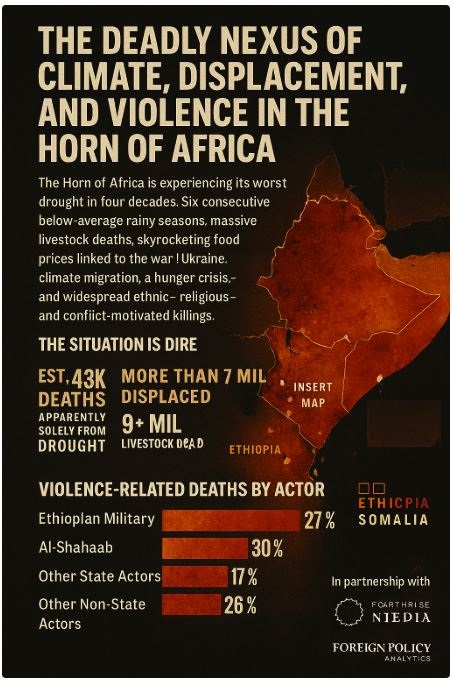
“CLIMATE ON THE BRINK: Mapping the Deadly Nexus of Droughts, Displacement, and Violence in the Horn of Africa.”
Dry, stormy clouds loom overhead. Borders glow subtly red, indicating rising tension. It evokes urgency and impending crisis.
Mapping Climate Hazards: The Ruling of Drought
The statistics shout, but the territory shouts more. This has seen five successive rainy seasons fail in sections of Ethiopia and Somalia. Villages have been swallowed in dust. Jerry cans are moved further along than schools by children. Cattle fall dead in fields bleached in the sun. FAO thinks that over 13 million individuals in Kenya, Somalia, and Ethiopia are acutely food insecure.
It is not about tomorrows, says Abdirashid Nur, it is about yesterday, today, ay, and tomorrow. He was one of the five climate leading scientists who were gathered to check the results of the Climate Conflict Vulnerability Index (CCVI).
The tool rightly extracts the Somalia region of Ethiopia, Garissa in Kenya, and Gedo in Somalia as hotspots. However, to the people in it, the confirmation is not comforting- it is a death sentence already executed. This is not cyclic, adds Ressa Kombi, a climate systems analyst. This is slow-motion collapse.” The vegetation of the southern part of Somalia has been found through satellite data to have reduced by 42%. Meteorological bases all over the Horn reveal lengthy precipitation abnormalities.
This is the fifth consecutive year of failed rainy seasons in Ethiopia and Somalia. It is not only the rains that are delayed as it used to happen in the past, but rains have ceased in places where people in the Somali region of Ethiopia are found, adds Abdirashid Nur.
These results are consistent with the data on the Climate Conflict Vulnerability Index (CCVI) climatic data. It identifies sections of northeastern Kenya, southern Somalia, and eastern Ethiopia as risky, drought-prone areas. According to Ressa Kombi, the climate hazards are becoming more and more prolonged and multidimensional. It is not only individual droughts of which we are seeing the effects, but the effects have become cascading impacts, adding livestock loss to urban migration.
Conflict Hazards: The water is blood
Scarcity does not only kill. It divides. The presence of wells has become a source of conflict in the area between Isiolo and Baidoa. Raids of cattle convert into massacres. On dried-up river-beds, the boundary-line is not the boundary-line–it is the line of battle.
Christophe Hodder, the Climate Security Advisor to the UN in Somalia, says, The accelerant is climate.” “And it is because inequality, marginalization, and a past of unresolved grievances fire it up.”
The year 2022-2025 represents an increase in resource-based conflicts by 60 percent in arid areas in Kenya. ACLED records an invariable connection between the occurrence of droughts and violent incidents. The venture of the Climate Conflict Vulnerability Index (CCVI) in mapping conflict risks is in line with the horrors experienced in Oromia, Turkana, and Jubala, nd. Hodder continues to add, “It does not only occur at a local level, but it is a national disaster with ramifications abroad.”
Climate is covered with a layer of war. In Somalia, clan competition overgrazing surfaces broke out into complete warfare. Access to water has been a sore point in Ethiopia, which has escalated intercommunal violence. Climate is a threat multiplier, as Elvin Nyukuri says. When there is tension in history, climate stress sparks it. Areas such as the Oromia region of Ethiopia and the Turkana-West Pokot corridor in Kenya, which are among the hot zones of conflicts, have been correctly identified under the CCVI.
Vulnerability: The Exposure in Climate and Conflict
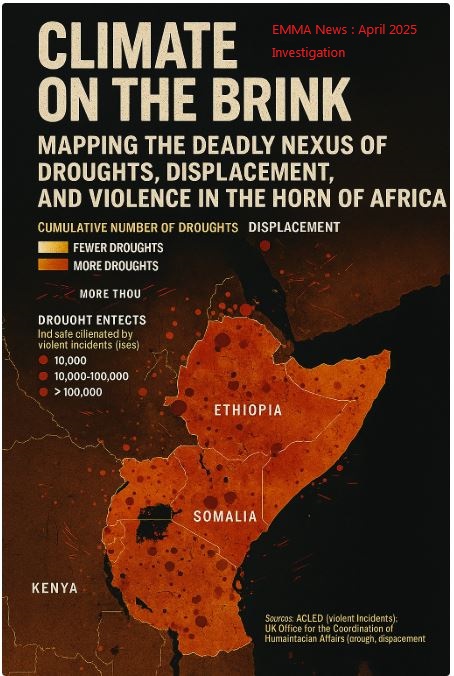
@Ethiopian Mass Media Generated Investigation Report
The atmosphere is scorching, barren, and desperate.
map pinpoints drought-prone areas (Somali region of Ethiopia, Garissa in Kenya, and Gedo in Somalia) in red shading.
Vulnerability has nothing to do with being the target. It is about those who cannot get up later on, notes Jackie Malomba, a Kenyan development researcher. Her work, and the work of such specialists as Nasra Dahir Mohamed and Martin Okonji, breaks apart the quiet architecture of poverty: female-headed households, landless. Communities that have been displaced with no provision of aid. Young people are stuck between a lack of work due to climate change and the appeal of extremism. The 20+ indicators that yardstick the Climate Conflict Vulnerability Index (CCVI) background are the household income, displacement records, access to infrastructure, and access to simple services. Nevertheless, local scholars claim that indicators tend to neglect slum settlements, local adaptations, and gender-specific exposures. According to Ayan Mahamoud, the data is aware of numbers. However, it does not always know people.”
According to research conducted by the Rift Valley Institute in southern Ethiopia, displaced families living in the region are exposed to a triple threat (drought, lack of access to relief aid, and political invisibility).
Jackie Malomba holds that vulnerability is both a matter of exposure and capacity: the exposure is given to women-headed households, displaced families, and pastoral communities become more exposed due to a lack of access to credit, land, and decision-making.
Burhaan Warsame says conflict vulnerability is due to poor governance and institutional marginalization. Such variables are established in the Climate Conflict Vulnerability Index (CCVI), but professionals caution about underreporting both in informal settlements and along geographical borders.
A storm in a teacup: the Climate-Conflict Overlap
When climate hazards are the match, and conflict hazards the gasoline, then vulnerability is the dry forest waiting to burst. The occurrence in South Somalia also witnessed the displacement of 300,000 people by El Niino which then fought with the host society over the limited food. In Kenya, pastoralists would invade pastures in other territories as pastures shrank in the north.
The 17 validation workshop professionals agreed that research regions such as Lower Juba, Marsabit, and Borena are susceptible to the convergence zone effect- the triple threat transition of climate, conflict, and vulnerability heightens destruction. Ayan Mahamoud says that the world is connected. And all is so precarious.
David Ngira notes the way the El Niño patterns have caused localised flooding in one part of the world but caused drought in another part (again, a factor in increased competition and displacement). Ahmed Yousuf Abdi continues: We have to cease making a distinction between these issues. They belong to the system breakdown.”
Ways out of Vulnerability
The moon would tell the rains. Nowadays, the moon too is silent, says Halima, a pastoralist of Garissa in Kenya. The youth displaced in Mogadishu list the greatest fear as a conflict over wells.
The elders in the Somali region of Ethiopia complain of lost grazing routes and the emergence of new border tensions. Language was the challenge that faced the validation workshops right off the bat. What is a climate event? What is a conflict? Does someone get to make decisions on which vulnerabilities are the most important?
Definitions are not only academic. According to Nasra Dahir Mohamed, they are political. There was squabbling between specialists on whether data collected in conflict areas could be relied upon; the informality of settlements meant that demonstration of activities such as land use and commuting patterns could not be shown, and policy models ignored pastoralist economies. Still others questioned how satellite-based data could fail to pick up stress in underground water, or how urban climate stress would be different from that in the countryside. Malomba says, referring to the database, it is nothing but surveillance without dignity.
In general, the Climate Conflict Vulnerability Index (CCVI) stands up.
The way it triangulated climate and conflict hotspots remarkably got recognition from most people in their field. Another problem is vulnerability, though. Nazanine Moshiri says it needs surgery, but not a band-aid. She noted the inconsistencies in cross-border displacement, the usage of oldland census input, and lathe ck of cultural risk factors like clan dynamics. As Dulmar Maalim made sure to point out, it is not only the weapons that create conflict risk.
It is a matter of the loss of trust, networks, and hope.”
It is being monitored by governments. The Ministry of Environment in Kenya has started pilot-testing CCVI to sub-county climate risk plans. Ethiopia Climate Commission uses it as a potential means to enhance anticipatory governance. The Ministry of Humanitarian Affairs of Somalia describes it as the best digital signal flare of the decade.
IGAD, the Intergovernmental Authority on Development, is also championing integration within the region. An official in the IGAD saiWe We cannot afford 8 climate tools in 8 countries. We can have our lens in CCVI.
The ministers of Ethiopia, Djibouti, and Uganda celebrated the potential of the tool in a regional policy dialogue in Nairobi. Someone added, “But data has to be translated into dollars.” People can not consume maps.
Data in the form of Climate Conflict Vulnerability Index (CCVI) -style is already being utilised by the World Bank and UNDP in planning. Recently, the tool was reconciled by the African Union through the Peace and Security Council.
A regional advisor to the UNDP added that we need more harmonized ecosystems of data. CCVI is an excellent foundation, and must be more African.
The Unheard Warnings-Community Voices.
The suppressed Lowing of hungry cattle speaks on Halima, a pastoralist in Garissa, Kenya: the elders say we outraged the skies. But this may not be the sky-they are the government that has forgotten us.”
Meanwhile, a displaced youth who goes by the name Aweis, in Gedo, Somalia, says, “We fled drought”. They discovered bullets.” A farmer in Oromia said to the researchers: When the river died, so did our peace.
By means of those narratives, one can see the emotional and existential trauma of climate collapse. They also belong to the profound detachment between the technocratic design and real lives. Halima states that we must be in the data and not discuss it.
Global Opinions: Is the World Catching up?
Keen minds at the African Union indicate that the cycle of response and recovery can only be broken by having tools such as CCVI at their disposal. Its use has been of interest to the UNDP and World Bank to use CCVI as one of the screening processes in regard to development aid. ICRC, FAO, and UNEP have acknowledged CCVI methodology and propose to modify it for rapid response planning.
One of the UNDP officials said, “You can not bank resilience when you cannot map it. CCVI is a string of lights in a pitch black tunnel.”
However, the concerns exist. Who is keeping the tool? What is the process of local data validation? And what about the communities to interpret the results? Not an issue of technology, rather it is political determination.
New Model of the Horn: the Climate Conflict Vulnerability Index (CCVI)
The Climate Conflict Vulnerability Index (CCVI)was borne out of the urgent necessity of having a data-driven Vision, and what the Climate Conflict Vulnerability Index (CCVI) does, unlike many others are afraid to do, is to map out where Climate stress and Human insecurity interact. The Climate Conflict Vulnerability Index (CCVI)is a new instrument to guide the path ahead in the swelling sea of instability because it is created with open-source data, detailed to a subnational level, and is updated quarterly.
However, beneath its flashy interface and thick methodology, there hides,s the one burning question: is it a hoax going on in the horn of the authors of the index, Avery Elizabeth Fiftal, one of its lead scientists, says, “We did not intend to create an ideal tool.” We created it to initiate open discussions. And here in this part of the world, those are life or death chats.”
The Climate Conflict Vulnerability Index (CCVI) draws on conflict data (ACLED, UCDP) and climate indicators (SPI, NDVI) and vulnerability statistics (World Bank, UNHCR, FAO) under the support of scientific organizations. The tool has undergone testing in workshops in Africa, Asia, and the Middle East. Nevertheless, validation is also one of the most complicated and urgently needed areas in East Africa.
No model can be perfect. Among the 17 experts, the major gaps in the Climate Conflict Vulnerability Index (CCVI) are the following:
- Underranging of conflict within rural and cross-border areas
- Scarcity of data about informal settlements and internal displacement
Lack of indigenous and traditional knowledge in measurements of vulnerability
• Poor, genderr, race and youth disaggregation
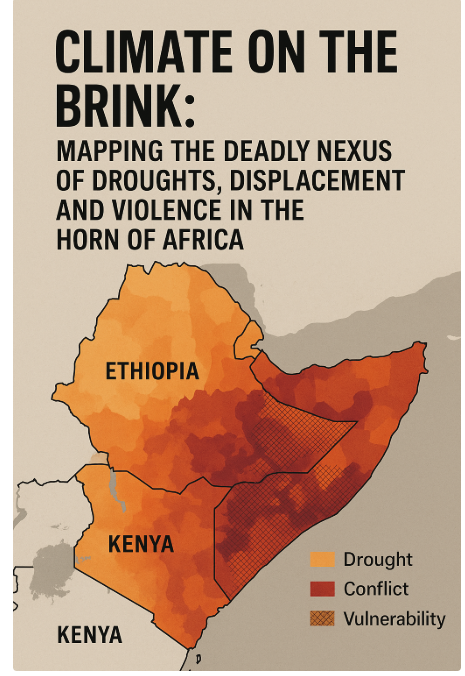
A researcher Dulmar Maalim declares, we should cease conceiving data as neutral. It is a show of force- and in many cases, uusesthit usthisices of the most vulnerable.
The Climate Conflict Vulnerability Index (CCVI) has been developed through open-source transparency and supported by advanced modeling to monitor climate and conflict risks every quarter at the subnational level. It is supposed to support the decision-makers with real-time and real-location risk data. But how accurately does it describe lived realities in such countries as Kenya, Ethiopia, and Somalia?
Avery Elizabeth Fiftal, one of the lead researchers, explains that: “We designed Climate Conflict Vulnerability Index (CCVI) as a decision-support but not a crystal ball.” It is essential to validate. This is why the workshops are important.
The Climate Conflict Vulnerability Index (CCVI) is not a silver bullet. It is a loaded gun of opportunity, however–responsibly used. It can inform preventive action, influence policy, and allocate assistance even prior to crisis occurrence. However, only when it can hear the voices that lie behind the metrics.
The Horn of Africa is the place of convergence of the climate and conflict, and the map is as good as the road it traces. At least, the Climate Conflict Vulnerability Index (CCVI) is going in the right direction. The following will see the world.
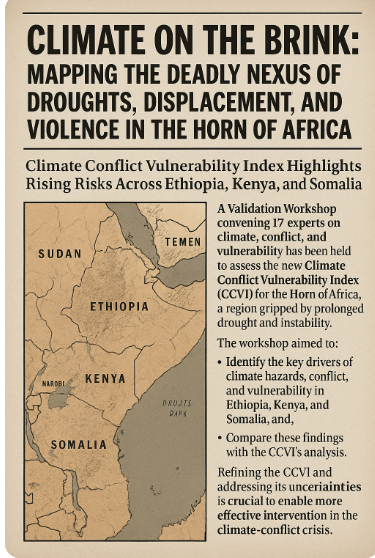
#ClimateSurvivors
#PastoralistVoices
#CommunityResilience
#HopeInCrisis
#WomenForClimate
#YouthForResilience
ClimateOnTheBrink #CCVI #ClimateConflictNexus #IGAD #EastAfrica #ClimateSecurity #MapTheRisk #ClimateVulnerability #ClimateAction #ResilienceMatters #VoicesFromTheFrontline #DataForPeace #IGADClimateAction #HopeInCrisis #PeaceAndClimate #OpenClimateData
By Ayele Addis Ambelu: Lead Investigator; contributors: Amisale Genete Demelew ; Eleshadaye Amanu; Mohammed Kassaw, Assres Y. and Yeworkweha Haile Girma,
@EMMA News: licensed by the Ethiopian Media Authority as a digital media Ethiopian Mass Media Action (EMMA NEWS) outlet, both Amharic and English, in the trade slices of ARMA Mult Media
Exodus at Ethiopia’s Western Gate: Gambella Overwhelmed as Tens of Thousands of South Sudanese Refugees Flood In
By Awot Haileslassie Gebrekidan | Gambella, Ethiopia The dusty borderlands of Ethiopia’s Gambella region have once again become a theater of human survival. In recent months, a staggering 50,000 South Sudanese refugees—most of them women and children—have poured across the border, fleeing fresh violence and hunger in their war-scarred homeland. The influx adds to the […]