
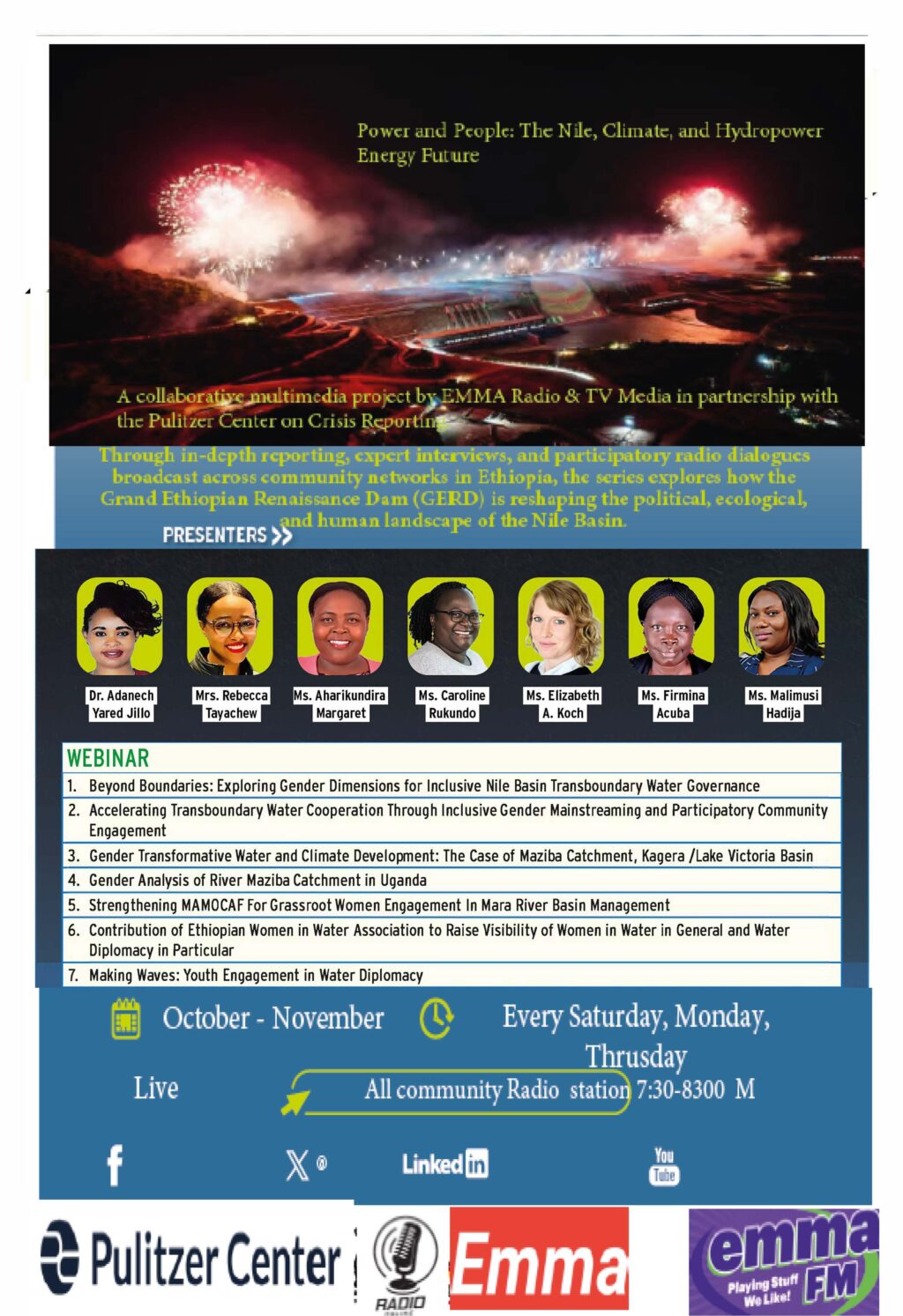
A joint program by EMMA Radio & TV Media and the Pulitzer Center on Crisis Reporting
The Nile is not only a river, it is memory, identity, and negotiation.
From Ethiopia’s highlands to Egypt’s delta, its waters sustain millions and stir nations.
As Ethiopia’s Grand Renaissance Dam rises on the Blue Nile, the debate deepens: who truly benefits, and whose voices are missing from the story of power and progress?
The River That Divides and Unites
“From the Ethiopian point of view, a modern dam is what will make their country a modern state.” — Ann Neumann, Pulitzer Center, “Hydropower”
Across centuries, the Nile has inspired unity and conflict, feeding both dreams and divisions. The Grand Ethiopian Renaissance Dam (GERD), a symbol of national pride, represents Ethiopia’s ambition to electrify the future.
Yet as the Pulitzer Center’s Hydropower reports, this project has also “roiled democratic relations in the Horn of Africa,” raising urgent questions of governance, equity, and cooperation.
Through its series “Power and People: Ethiopia’s Climate and Energy Future,” EMMA Radio & TV Media explores these questions not from ministries, but from marketplaces, riversides, and classrooms—where real lives intersect with policy.
Gender, Power, and Participation
“Water is a strategic resource and an essential element of security, yet women’s voices in water diplomacy remain insignificant.” — Dr. Adanech Yared Jillo, President, Ethiopian Women in Water Association
In the 7th Nile Basin Development Forum (NBDF) Webinar on Gender Dimensions in Transboundary Water Management, experts called attention to an old truth in a new context: women carry the weight of water but not the power to govern it.
Dr. Jillo told EMMA Radio that the Nile Basin’s governance suffers from a chronic gender gap.
“Even where women are present,” she said, “they are often confined to community-level engagement rather than regional decision-making.”
This echoes the social silencing Ann Neumann documented in Hydropower:
“The Abiy administration has used the same tactic to quash dissent regarding their management of the GERD—by silencing media and spreading misinformation.”
Silence, whether political or gendered, has the same effect: it removes people from the table where their lives are being discussed.
At the Water’s Edge: Stories from the Basin
“Women are not just participants; they are mediators, negotiators, and innovators.” — Ms. Malimusi Hadija, Mara-Mori Catchment Forum, Tanzania
From Uganda’s Maziba catchment to Tanzania’s Mara River, women are proving that inclusion works.
In the NBDF webinar, Ms. Firmina Acuba, a gender and water governance specialist, shared that water scarcity forces women to sacrifice education and employment opportunities. “They bear the brunt of adaptation,” she said. “But without policy space, their solutions remain invisible.”
Ms. Hadija recounted how her forum began with fewer than ten women, and none in leadership. “Today, we have women leading dialogues across borders,” she said proudly. “This is what transformation looks like.”
These voices turn the abstract politics of water diplomacy into a lived reality, a theme EMMA Radio amplifies through participative radio forums and digital storytelling.
The Diplomatic Stream
“Water diplomacy is not limited to ministers. It includes civil society, youth, and women.”, Elizabeth Koch, Environmental Law Institute / SIWI
As discussions on the GERD ripple through the region, transboundary diplomacy is too often portrayed as a matter for men in suits and state flags. Yet, as Elizabeth Koch reminded the NBDF audience, durable peace depends on inclusive participation.
She cautioned: “When young people and women are excluded from transboundary governance, we lose creativity and legitimacy.”
Her warning reflects a deeper truth Neumann captures in Hydropower:
“The two countries never managed, or maybe never wanted, to go beyond their mutual distrust to find a common approach to the water.”
The failure of trust, between nations and between genders, remains one of the Nile’s most persistent undercurrents.
Legal and Institutional Frameworks: Toward Cooperation
“Gender equality is not an accessory to governance, it is its foundation.” , Dr. Adanech Yared Jillo
Legal and institutional reform in the Nile Basin requires more than treaties. It requires transformation.
Experts in the TG1 report highlighted that without mainstreaming gender in transboundary water agreements, basin cooperation will remain partial and fragile.
As Dr. Jillo told the EMMA program:
“Building women’s technical skills, leadership visibility, and participation at all levels is not just good policy, it’s intelligent diplomacy.”
The Nile Basin Initiative (NBI) has taken steps toward gender inclusion through its Gender Strategy, yet implementation varies across states. The challenge, experts say, lies not in laws but in political will.
Heritage, Faith, and the Flow of Change
From Ethiopia’s Lake Tana, believed to have sheltered the Ark of the Covenant, to the wetlands of South Sudan, the Nile is not just a river. It is heritage.
For generations, women have been its keepers: managing water, mediating conflict, preserving ecosystems.
“Water is life, but it is also legacy,” Dr. Jillo said. “Excluding half the population from managing it means excluding half the wisdom of our societies.”
In Hydropower, Neumann observed that the GERD was “woven deeply into the fabric of nationalist narrative.”
But EMMA’s reporting reminds us that the deeper story lies not in turbines, but in transformation—of gender norms, governance systems, and global responsibility.
Energy for All, Dialogue for All
Ethiopia’s hydropower ambitions are immense, 6,500 megawatts from the GERD alone. But energy access is not just a question of electricity. It is a question of equity.
“Even though the GERD has rallied massive numbers of Ethiopians behind Abiy,” Neumann wrote, “they are left wondering: where is the infrastructure to deliver on the dam’s promises?”
The same question drives women across the Nile Basin: where is the infrastructure, social, economic, and institutional, to deliver on equality’s promise?
Women’s voices in water: The Shared Flow: The River That Divides and Unites
Across the Horn of Africa, the Nile flows like a living memory: ancient, restless, and political. Its waters nourish millions from the Ethiopian highlands to the Egyptian delta, yet the river also divides nations and histories. The Grand Ethiopian Renaissance Dam (GERD), the largest hydropower project in Africa, stands as both a symbol of progress and a flashpoint of tension.
As Pulitzer Center grantee Ann Neumann writes in Hydropower,
“From the Ethiopian point of view, a modern dam is what will make their country a modern state.”
For many Ethiopians, GERD is not merely a dam; it is a promise. A promise of light where there was darkness, opportunity where there was scarcity. Yet this same dam has triggered diplomatic storms and raised urgent questions of justice, participation, and power, not just between countries, but between men and women.
At the heart of the Nile story lies a question that transcends politics: Who gets to shape the future of water?
The Missing Voices in the Water room
In our webinar on Gender Dimensions in Transboundary Water Management, Dr. Adanech Yared Jillo, President of the Ethiopian Women in Water Association (EWIW), issued a reminder that rippled through the discussion.
“Water is a strategic resource and an essential element of security,” she said. “But women’s voices in water diplomacy remain very low or insignificant.”
Dr. Jillo explained that across Nile Basin states, women face systemic barriers to decision-making. Despite their frontline role in water collection, food production, and ecosystem management, they are often excluded from policy and negotiation spaces.
“Limited representation, social stereotypes, and lack of technical recognition continue to confine women’s roles to the community level,” she added.
Her words echo the same exclusionary pattern described in Hydropower, where Neumann writes:
“The Abiy administration has used the same tactic to quash dissent regarding their management of the GERD by silencing media and spreading misinformation.”
The silence, whether political or gendered, is not accidental. It is structural. Both in the halls of power and in the rural villages along the Blue Nile, voices are often muted by hierarchy.
Lessons from the Catchment: Women on the Frontline
In Uganda’s Maziba catchment, Ms. Firmina Acuba, a gender and water governance specialist, presented a revealing study:
“Water scarcity has proven to be a burden for women, causing them to sacrifice work, education, and even family care.”
Her findings, shared at the NBDF forum, show that women bear disproportionate impacts of climate stress and water degradation. In households where men control land ownership, women have little authority over water allocation or adaptation decisions.
“Women can access land,” Acuba explained, “but rarely control it. Decisions about what to plant or how to manage the land remain the preserve of men.”
The result is an invisible inequity — one that mirrors the imbalance Neumann witnessed in Ethiopia’s hydropower dream. In Hydropower, she describes the irony of a modernizing nation still shadowed by exclusion:
“Ethiopians are left wondering: Where is the infrastructure, domestic and international, to deliver on the dam’s promises?”
Women like Acuba’s respondents are still asking the same: Where is the infrastructure, political and social, to deliver on equality’s promise?
Diplomacy Beyond the Boardroom
The Nile Basin is not short on high-level meetings. But as Elizabeth Koch, senior expert at the Environmental Law Institute and Stockholm International Water Institute (SIWI), emphasized during the webinar:
“Water diplomacy is not limited to statesmen and ministers. It includes civil society, youth, and women because they all can create solution spaces for conflicts over water.”
Her intervention reframed transboundary water governance as a shared civic responsibility rather than a closed diplomatic circle.
“Failure to include young people and women equitably,” Koch warned, “has direct costs to political decision-making at transboundary levels. It undermines cooperation and sustainable management.”
This idea resonates with Neumann’s reflection on the fragility of Nile relations:
“Tensions between Addis Ababa and Cairo did not begin with the massive infrastructure projects of the last two centuries… The two countries never managed, or maybe never wanted, to go beyond their mutual distrust to find a common approach to the water.”
The distrust between nations, Koch suggests, mirrors the distrust between genders and generations in water governance; both erode cooperation, both stifle innovation.
Women at the Water’s Edge
In Tanzania’s Mara River Basin, Ms. Malimusi Hadija from the Mara-Mori Catchment Forum (MAMOCAF) offered a story of transformation.
“When MAMOCAF began, fewer than ten women joined, and none held leadership roles,” she told EMMA Radio. “Today, after years of advocacy, we have women champions leading dialogues across communities and borders.”
Hadija’s experience shows how local capacity-building, from training to awareness, can ripple upward, reshaping governance. “We learned that women are not just participants,” she said. “They are mediators, negotiators, and innovators.”
Her words echo Neumann’s depiction of hope amid hardship in Hydropower:
“The desperate need for something to look forward to, for a better life for future generations, has made tempering the GERD’s unilateral path forward unthinkable.”
Just as Ethiopians crowd-funded their dam, women across the Nile Basin are self-funding their empowerment through persistence, knowledge-sharing, and sheer resolve.
Policy and Power: Toward Inclusive Governance
At the policy level, experts in the TG1 report stressed that gender inclusion in water diplomacy is not an add-on, it is a prerequisite for sustainable peace and equitable resource use.
Dr. Jillo summarized this vision:
“Gender equality is central to achieving cooperative water management. Building women’s technical skills, leadership visibility, and participation at all levels is critical for the resilience of our shared waters.”
Yet progress is uneven. Institutional reforms remain slow, funding scarce, and patriarchal norms resilient. The Nile Basin Initiative’s Gender Strategy, launched in recent years, calls for “mainstreaming gender in all transboundary frameworks,” but implementation depends on national will.
Neumann’s Hydropower captures the same paradox on the national scale:
“Even though the GERD has rallied massive numbers of Ethiopians behind Abiy, they are left wondering: Where is the infrastructure to deliver on the dam’s promises?”
The Nile’s governance may be regional, but its inequalities are profoundly local.
The River as Heritage and Hope
The Nile is more than water; it is identity, heritage, and survival. As Dr. Jillo poignantly noted,
“Water is life, and in our context, it is also legacy. Excluding half the population from managing it means excluding half the wisdom of our societies.”
From Bahir Dar’s Lake Tana, the sacred source of the Blue Nile, to the floodplains of South Sudan, women’s knowledge of the river runs deep. It is encoded in rituals, songs, and survival strategies. But in policy papers and boardrooms, that knowledge is often erased.
Neumann’s Hydropower situates this erasure in the politics of modernity:
“The Grand Ethiopian Renaissance Dam was woven deeply into the fabric of nationalist narrative… banners proclaimed: IT’S MY DAM. AFRICA SHALL CHANGE NATURAL GIFTS TO CONCRETE BENEFITS.”
But as EMMA Radio’s reporting makes clear, the truest renaissance will not be measured in megawatts; it will be measured in participation.
The Shared Flow
The Nile, like gender equity, is a story of shared survival.
It cannot be governed by exclusion or dominated by one voice, whether national or patriarchal.
As the experts of the NBDF and the storytellers of Hydropower remind us, the real test of progress is not the size of the dam, but the inclusiveness of the dialogue.
“Gender equality and youth participation,” Dr. Jillo concluded, “are not acts of generosity. They are acts of intelligence, because no sustainable cooperation can exist without them.”
From the highlands of Ethiopia to the delta of Egypt, the water flows on, carrying with it the dreams of millions. The challenge now is to ensure that every one of them, regardless of gender or geography, has a voice in how it is shared.
Produced by EMMA Radio & TV Media in collaboration with the Pulitzer Center.
Featuring insights from the 7th Nile Basin Development Forum (NBDF) Webinar on Gender Dimensions in Transboundary Water Management, and excerpts from Ann Neumann’s Pulitzer Center story “Hydropower.”
Join the Conversation: Power and People
EMMA Radio & TV Media, in collaboration with the Pulitzer Center, invites you to join the dialogue:
“Power and People: The Nile, Climate, and Hydropower Future.”
Tune in to our community radio network broadcasts across Ethiopia, or follow our online discussions.
Share your reflections, experiences, and questions about how gender, climate, and governance shape our shared river.
???? We want to hear from you.
Your voice matters — because every drop of water tells a story.
???? Email: emmanews23@gmail.com | ???? https://am.africanewschannel.org
???? Follow: #PowerAndPeople #NileVoices #PulitzerCenter
Credits
Produced by: EMMA Radio & TV Media PLC
Supported by: Pulitzer Center on Crisis Reporting
Project: Power and People: Ethiopia’s Climate and Energy Future
Story theme: Gender Dimensions and Transboundary Water Governance in the Nile Basin
Featuring expert insights from: Dr. Adanech Yared Jillo, Ms. Firmina Acuba, Ms. Malimusi Hadija, Elizabeth Koch, and the 7th Nile Basin Development Forum (NBDF).
Inspired by: Ann Neumann’s “Hydropower” (Pulitzer Center)
#PowerAndPeople
#TheNileFuture
#NileVoices
#HydropowerDialogues
#WaterForAll
#PulitzerCenterProjects
#EMMARadio
#ClimateAndEnergyAfrica
#FrancescaEkondaho
#Afy Malungu
#AwotHaileslassie
#GenderAndClimate
#SheShapesTheNile
#WomenInEnergy
#GenderEqualityNow
#ClimateResilienceAfrica
#FeministClimateJustice
#EmpowerWomenEmpowerWater
The River Speaks Back: Power and People: The Nile, Climate, and Hydropower Energy Future
#UNWater #WorldBankAfrica #AfricanUnion #NBI #UNSDG6 #ClimateChangeAfrica #HydropowerAfrica #EthiopiaDevelopment #EastAfricaNews #AfricanMedia