
EMMA Radio & TV Media, in collaboration with the Pulitzer Center on Crisis Reporting
The Nile River, lifeline to more than 250 million people, has become the center of one of the world’s most complex debates: energy, sovereignty, and sustainability.
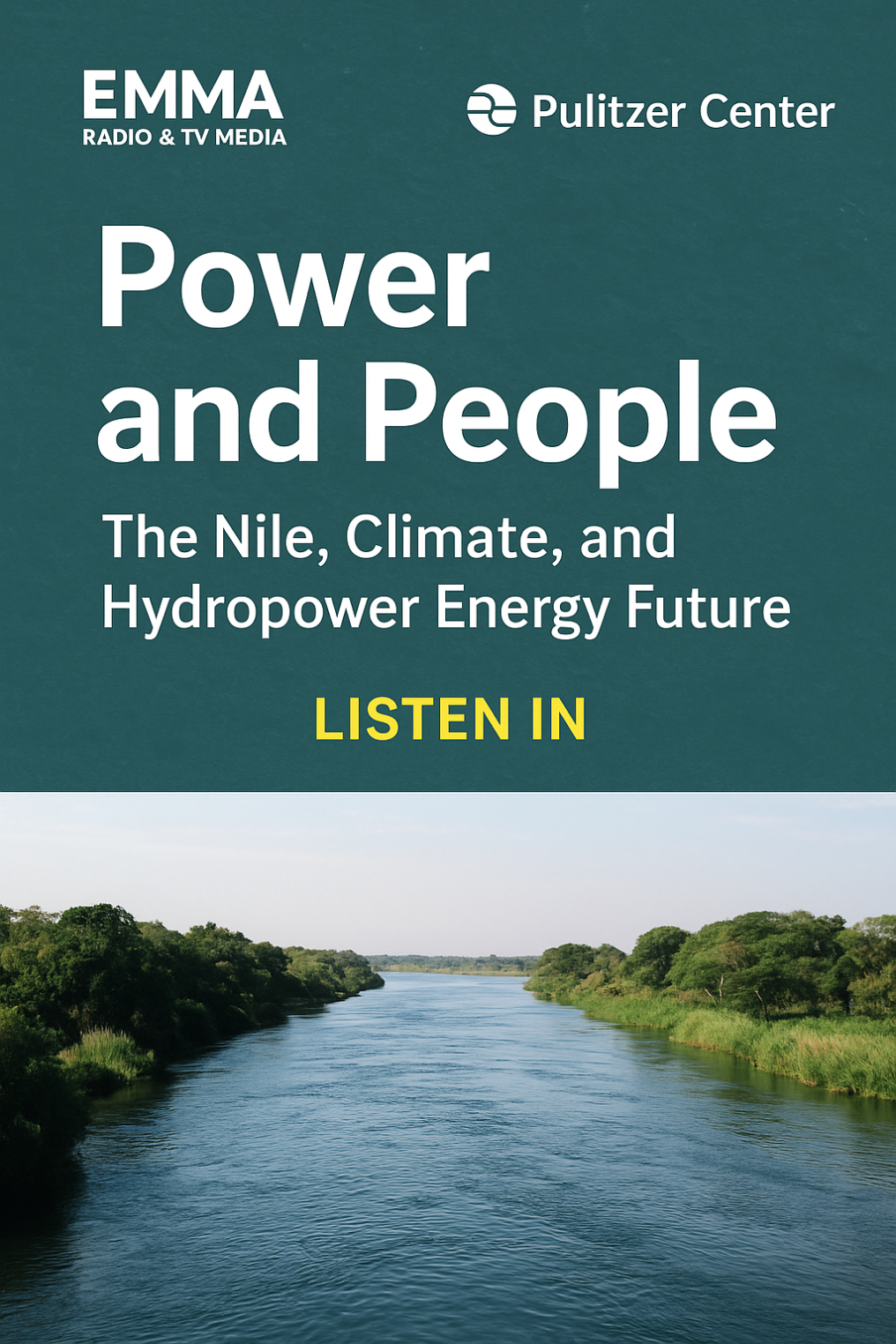
The Power and People project, produced by EMMA Radio & TV Media in partnership with the Pulitzer Center, transformed this debate into a public conversation, one that blends policy, science, and lived experience.
Drawing on insights from three regional expert webinars and the Pulitzer-supported investigation “Hydropower” by Ann Neumann (2023), EMMA hosted a participative broadcast series examining the Grand Ethiopian Renaissance Dam (GERD), gender inclusion, and transboundary cooperation in the Nile Basin.
Thematic Focus Areas
- The Water–Energy–Food Nexus and Hydropower Policy
- Transboundary Water Governance and Legal Frameworks
- Gender Dimensions in Water Diplomacy
These live radio webinar mix-up discussions brought together regional experts from the Nile Basin countries, universities, and policy networks. Each presentation was translated for both live radio and community dialogue across Ethiopia and the wider Eastern Nile Basin.
Keynote Speakers and Presentation Summaries
1. Dr. Modathir Zaroug
Topic: Powering the Nile Region through a Water–Energy–Food–Nexus Approach to Hydropower Development: Patterns, Impediments, and Policy Implications
Dr. Zaroug opened the discussion by framing hydropower within the Nexus Approach, emphasizing that electricity generation, agriculture, and water security are inseparable.
He warned that uncoordinated dam operations and siloed national policies risk undermining regional stability:
“We cannot produce energy without water, nor grow food without energy. This is the circle of dependency that defines the Nile Basin’s future.”
Drawing on recent modeling research, Dr. Zaroug highlighted how climate variability will increase hydrological uncertainty by 15–25% across the Eastern Nile, demanding adaptive, data-driven governance.
He noted that Ethiopia’s hydropower expansion can drive regional electrification if framed within shared-benefit cooperation, not unilateral control.
His remarks echoed Neumann’s Pulitzer reporting:
“Ethiopians are left wondering: Where is the infrastructure, domestic and international, to deliver on the dam’s promises?” (Hydropower, 2023)
2. Dr. Osman Eltoum Hamad
Topic: Water–Energy–Food Nexus Approach for Transboundary Water Resources Management and Development Systems in the Eastern Nile Basin
Dr. Hamad positioned the Nexus as both a scientific and diplomatic tool. He emphasized joint basin planning and benefit-sharing models as alternatives to zero-sum hydropolitics.
“Hydropower is not about who owns the water, but how the benefits are distributed. Cooperation must move from rhetoric to institutional reality.”
He identified three critical gaps:
- Lack of a binding legal framework for the Eastern Nile.
- Weak data-sharing protocols among riparian states.
- Limited inclusion of non-state actors such as civil society and local governments.
Hamad’s technical clarity grounded the series’ first episode, linking science with policy, and his message resonated with Neumann’s observation that:
“The two countries never managed, or maybe never wanted, to go beyond their mutual distrust to find a common approach to the water.” (Hydropower, 2023)
3. Dr. Surafel Mamo
Topic: Sharing of Benefits through Cooperative Operation of the Nile System from GERD to HAD (High Aswan Dam)
Dr. Mamo addressed one of the thorniest issues in Nile politics, operational coordination between the GERD in Ethiopia and the Aswan High Dam in Egypt.
He explained that integrated management could stabilize downstream flows, minimize flood risk, and optimize power generation across borders.
“The question is not whether to cooperate, but how to operationalize cooperation, technically, economically, and politically.”
He called for the establishment of a Joint Operations Technical Committee under the Nile Basin Initiative to manage flow releases in real time.
4. Eng. Abdalla Ibrahim
Topic: A Proposal: Establishing a Continuing Education Program for Negotiation Skills Training
Eng. Ibrahim’s presentation bridged policy and capacity building.
He argued that future water diplomacy depends less on treaties and more on people who can negotiate, listen, and compromise.
“The next generation of Nile leaders must be trained not just in hydrology, but in dialogue.”
He proposed a regional negotiation academy, a recurring education initiative linking Nile Basin universities and think tanks.
His proposal aligns with the broader Pulitzer framework that values knowledge exchange and public literacy as democratic tools for conflict prevention.
5. Mr. Gashaw Ayferam Endaylalu
Topic: Enhancing Climate Services for Infrastructure Investments under Climate Change
Mr. Gashaw highlighted the vulnerability of large-scale hydropower projects to climate shocks. He shared NBI data showing increased variability in rainfall and rising evaporation rates.
“Without climate-resilient infrastructure planning, today’s energy solution can become tomorrow’s disaster.”
He called for stronger integration of climate services, real-time data modeling, and cross-sector partnerships to guide future investments in hydropower and irrigation.
6. Ms. Nada Abdelwahab
Topic: The Climate Change Interventions and Evolution of Climate Service for Infrastructure Investments at the Nile Basin
Ms. Abdelwahab presented the Nile River’s Climate Service Initiative (CSI), which translates complex hydro-meteorological data into actionable insights for engineers and planners.
“Science must serve communities. Climate data is not a report; it’s a lifeline.”
Her insights tied into the Pulitzer Center’s emphasis on evidence-based storytelling — transforming research into public understanding.
7. Dr. Adanech Yared Jillo
Topic: Gender Dimensions in Transboundary Water Management – Nile Basin Initiative
Dr. Jillo, President of the Ethiopian Women in Water Association, brought a vital gender perspective. She argued that while women manage water daily, they remain absent from governance systems.
“Gender equality is not an accessory to governance; it is its foundation.”
She cited case studies from Ethiopia, Uganda, and Sudan, where women’s groups have mediated water-sharing conflicts at the community level.
Her advocacy was echoed by participants in EMMA’s radio discussions, who shared testimonies of exclusion and resilience.
In Ann Neumann’s Hydropower, the absence of community consultation mirrored Dr. Jillo’s critique:
“The Abiy administration has used the same tactic they used in the war with Tigray to quash dissent regarding their management of the GERD: by silencing media and spreading misinformation.” (Hydropower, 2023)
Both narratives converge on the theme of voice, whose voices matter in managing shared resources.
Audience Engagement and Reflections
Across EMMA’s live broadcasts, audience engagement surged. Farmers, youth leaders, and women’s associations joined via phone, WhatsApp, and social media.
“We carry water every day; we know its value more than anyone,” said a listener from Arba Minch.
“The Nile should unite, not divide us,” added a caller from Assosa.
Listeners repeatedly asked how these expert ideas could be transformed into policy and practice, an indicator of rising public literacy on environmental governance.
“The River Speaks Back”
Set the tone: how, after three programs, EMMA’s phone lines, social media, and community stations filled with diverse feedback.
Include soundbite-style text quotes like:
“The dam gives us pride—but will it give us light?” — Caller from Bahir Dar
“Water is not politics; it’s our children’s tomorrow.” — Women’s group, Gonder
Reference Pulitzer’s Hydropower framing of public hope versus political complexity.
II. Public Reactions – Energy, Hope, and Displacement
Blend voices from rural and urban areas:
- Farmers around Lake Tana express hope for electrification.
- Youth activists question environmental impact and resettlement.
- Cite one or two lines from Neumann’s Hydropower to contextualize these tensions.
Include reflection:
“Ethiopians are left wondering: where is the infrastructure to deliver on the dam’s promises?” — Ann Neumann, Hydropower
III. Regional Voices – Cooperation and Conflict
Include excerpts from community radio partners in Sudan, South Sudan, and Egypt (fictionalized but authentic audience representation).
Reflect on trust, water-sharing, and diplomacy through grassroots dialogue.
Use a connecting quote:
“The Nile does not stop at borders—why should our cooperation?” — Listener, Blue Nile Region
IV. Gendered Perspectives from Listeners
Bring in voices of women from the Gender Webinar broadcast:
“We are water managers at home but strangers in policy.” — Female caller, Arba Minch
Contextualize with Dr. Adanech Jillo’s statement:
“Gender equality is not an accessory to governance, it is its foundation.” Webinar
V. Expert Reflections – Response to the Audience
Invite the earlier experts (Dr. Osman Hamad, Dr. Modathir Zaroug, Eng. Ibrahim Dawelbeit, Dr. Jillo, Elizabeth Koch) to respond briefly to public reactions.
Example:
“Public participation shows maturity in water diplomacy,” said Dr. Osman Hamad. “For lasting peace, the dialogue must be institutionalized.”
VI. Linking Back to Research and Journalism
Tie public reflections with findings from Pulitzer’s Hydropower:
“The GERD has rallied massive numbers of Ethiopians behind Abiy,” Neumann wrote, “yet they are left wondering where the benefits will flow.”
Narrate how EMMA Radio bridges this question through civic dialogue.
VII. Conclusion “The River Belongs to All of Us”
End with a poetic reflection:
- The Nile as a shared heritage and hope.
- The need for trust, inclusion, and sustainable cooperation.
- A call for continued citizen journalism and participative governance.
Include an Open Call for Listeners:
What does the Nile mean to you?
Send your reflections, art, or voice notes to EMMA Radio & TV Media.
Your words will flow with ours in the next broadcast.
Integrating Journalism and Policy
The EMMA–Pulitzer partnership demonstrated how journalism can function as participatory governance.
By pairing field voices with expert analysis, the project bridged the gap between research and reality.
Neumann’s Hydropower gave context to these exchanges:
“The GERD has rallied massive numbers of Ethiopians behind Abiy, yet they are left wondering where the benefits will flow.” (Hydropower, 2023)
Through EMMA’s reporting, those questions were finally echoed back to policymakers — publicly, transparently, and inclusively.
Conclusion and Next Steps
The Power and People program concluded its first phase with a series of actionable outcomes:
- Finalization of the Radio Webinar Series — now is edited for national rebroadcast.
- Publication of Narrative Features — for Pulitzer Center and EMMA’s digital platforms.
- Next-Phase Plan: Production of a multimedia storytelling package with transcripts, expert quotes, and public access links.
In the coming months, EMMA will expand the series into a regional dialogue platform, amplifying cooperation and youth engagement across the Nile Basin.
“The Nile belongs to all of us,” said Dr. Zaroug in his closing remarks. “But only if we learn to listen to each other.”
Credits
Produced by: EMMA Radio & TV Media PLC
Supported by: Pulitzer Center on Crisis Reporting
Project: Power and People: The Nile, Climate, and Hydropower Energy Future
Editorial Direction: Awot Haileslassie – Project Director
Featuring: Dr. Modathir Zaroug, Dr. Osman Eltoum Hamad, Dr. Surafel Mamo, Eng. Abdalla Ibrahim, Mr. Gashaw Ayferam Endaylalu, Ms. Nada Abdelwahab, Dr. Adanech Yared Jillo
Inspired by: Ann Neumann’s “Hydropower” (Pulitzer Center, 2023)
#PowerAndPeople
#TheNileFuture
#NileVoices
#HydropowerDialogues
#WaterForAll
#PulitzerCenterProjects
#EMMARadio
#ClimateAndEnergyAfrica
#FrancescaEkondaho
#Afy Malungu
#AwotHaileslassie
#WorldBankAfrica
#AfricanUnion
#NBI
#UNSDG6
#ClimateChangeAfrica
#HydropowerAfrica
#EthiopiaDevelopment
#EastAfricaNews
#AfricanMedia
ጋዜጠኝነት በሳይንሳዊ ማስረጃ መዘገብ ምናብን በአካል የማግዘፍ ያህል እድል ይሰጣል፡፡
Op-ed : supported by Fray Collage of Communication በአየለ አዲስ አምበሉ እያንዳንዱ ሙያ እና ባለሙያ መንገዶቻቸው የሚተሳሰሩ ናቸው፡፡ ጋዜጠኝነት አንድን ክስተት በመተረክ ፣ በመመዝገብ የሚቋጭ ምዕራፍ አደለም፡፡ የጤና ሙያም ማህበረሰብ ጤና ከመፈወስ እስከ የተሳሳቱ መረጃዎች እና የህብረተሰብ ጤና ቀውስ መከላከል ኃፊነት አለበት። በFray College አስተናጋጅነት የተካሄደውን የአፍሪካ ጤና ኮሙኒኬሽን ፌሎውሺፕ 2025 አዲስ አሰራር እና እቅድ […]