
EMMA NEWS | Ethiopian Mass Media | Newspaper
Issue 12, No. 52 | November 11, 2025
By Kiddus, Meselech Zelalem & Ketema Ambelu @emmanews23@gmail.com
Africa’s insurance and reinsurance industry has long been spoken about in the language of deficits, low penetration, weak trust, thin capital, and fragmented regulation. But in the center of Africa Union, Addis Ababa, and the cap town table mountains at a pivotal continental gathering captured in the reinsurance Continental agenda, a different narrative began to take shape. It was not a defensive story of what Africa lacks, but a bold, collective declaration of what Africa is building. From regulators and reinsurers to innovators and development partners, voices converged around a singular message: Africa’s risk story must now be told by Africans themselves with confidence, clarity, and continental ambition. The 10th Continental Reinsurance CEO Summit, held in Cape Town alongside the company’s 40th anniversary, emerged as a defining moment for Africa’s reinsurance industry, blending reflection with forward-looking debate on leadership, regulation, capital strength, and technology. The gathering brought together regulators, reinsurers, and industry experts at a time when Africa’s risk exposure is rising faster than its insurance coverage, reinforcing the strategic importance of reinsurance across the continent.
“This Summit is not just a milestone event; it is a moment to align our collective vision for Africa’s reinsurance future,” said Mutsunge Lawrence Nazare, Group Managing Director of Continental Reinsurance, as he opened the forum. “From our humble beginnings in 1985, we have grown alongside the African market, adapting to change while remaining committed to resilience, partnership, and long-term value creation.”
At the heart of the discussions was a recognition that risk in Africa is no longer peripheral. Climate shocks, health crises, food insecurity, infrastructure exposure, and digital vulnerabilities have moved from abstract threats to daily realities. “Insurance is no longer a luxury product for a few; it is a public good for resilience,” emphasized Hikmet Abdullah, Chief Executive Officer of FSD Ethiopia, as she opened the forum. Drawing directly from the transcript, she framed the industry’s challenge as a moral and economic imperative, noting that millions of Africans remain exposed to preventable shocks despite years of premium growth. Her remarks echoed the findings of the African Development Bank, which has repeatedly warned that uninsured risks are now among the biggest constraints to Africa’s development financing and poverty reduction efforts.
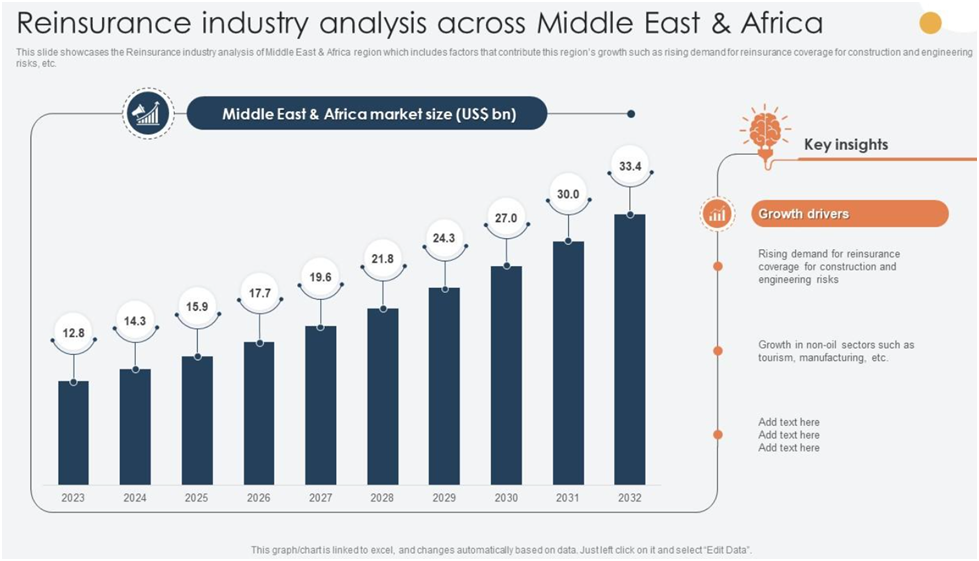
The numbers tell a story of momentum, but they also whisper a warning. Across Africa, the reinsurance market is on a steady upward climb, expanding from an estimated US$12.8 billion in 2023 to a projected US$33.4 billion by 2032, according to industry projections illustrated in the accompanying market-size chart. At first glance, the trajectory signals confidence, rising demand, and renewed investor interest. But beneath the bars and curves lies a deeper truth: Africa’s risk exposure is growing faster than its protection mechanisms.
The reinsurance growth curve, rising almost year by year, is driven by familiar forces. Infrastructure booms, large-scale construction projects, energy investments, and rapid urbanization have significantly increased demand for engineering and construction risk coverage. Non-oil sectors, particularly manufacturing, transport, tourism, and agribusiness, are expanding across Africa, creating new classes of insurable assets and liabilities. This dynamic is not speculative. It was echoed repeatedly by industry leaders and regulators during the Addis Ababa insurance and Cape Town reinsurance forum, where, in an exclusive interview described reinsurance as the “silent backbone” of Africa’s development financing.
Yet the same data that signals opportunity also exposes a structural imbalance. While market size is growing, insurance penetration across most African economies remains stubbornly low, often below one percent of GDP. Reinsurance growth, analysts argue, is therefore not a reflection of deep insurance inclusion, but of concentrated exposure at the top end of the economy. As Hikmet Abdullah, CEO of FSD Ethiopia, observed during the forum, premium growth alone masks the reality that millions of households, farmers, and small enterprises remain completely uninsured. “Risk is expanding faster than coverage,” she warned, framing the issue as both a development and stability challenge.
This gap between exposure and protection is precisely where reinsurance should play its most transformative role. Reinsurers are not merely balance-sheet shock absorbers; they are risk aggregators, data engines, and market disciplinarians. However, as highlighted by Salomon Desta, Vice Governor of the National Bank of Ethiopia, the effectiveness of reinsurance depends heavily on regulatory maturity. His remarks on Africa’s transition toward risk-based capital supervision reflect a wider continental shift. Regulators are increasingly demanding stronger capitalization, better governance, and more transparent risk reporting reforms that reinsurers have long advocated as prerequisites for sustainable underwriting.
EMMA News steady ascent also raises a critical question: who is capturing this growth? Industry research from the African Insurance Organisation and global reinsurers shows that a significant share of African risk continues to be ceded outside the continent. This outward flow reflects limited local reinsurance capacity, fragmented regional markets, and uneven regulatory frameworks. During the Addis & cap town discussions, Mr Yared Mola, President of the Association of Ethiopian Insurers, was unusually blunt, cautioning that price undercutting, weak data sharing, and an overreliance on motor insurance are eroding market discipline and discouraging long-term reinsurance investment. His assessment aligns with broader African reinsurance analyses that warn of a market growing in size but not yet in depth.
Climate risk looms large over this debate. The upward bars in the reinsurance market chart do not explicitly account for the escalating cost of floods, droughts, storms, and heatwaves now reshaping Africa’s risk landscape. According to global reinsurance research, climate-related losses in Africa are increasing in frequency and severity, even as coverage remains thin. Speakers at the forum emphasized that without scaled parametric insurance, regional catastrophe pools, and sovereign risk transfer mechanisms, future losses could overwhelm both insurers and governments. In this context, reinsurance is no longer a back-office financial product; it is a frontline resilience tool.
Technology offers a partial bridge between growth and inclusion. The Addis forum highlighted how satellite data, AI-driven risk modeling, and digital distribution can reduce underwriting costs and expand coverage into previously unviable markets. These innovations help explain the optimistic projections shown in the market-size chart. But William Mzimba, former CEO of Vodacom Africa, cautioned that technology alone cannot close Africa’s protection gap. Without skilled actuaries, credible claims systems, and trusted institutions, growth risks becoming brittle. As William Mzimba noted during the discussions, “A fast-growing reinsurance market without strong fundamentals is like a tall building without deep foundations.”
What makes the current moment distinctive is the emergence of a Pan-African reinsurance consciousness. Leaders no longer frame risk in purely national terms. Infrastructure corridors, climate systems, and capital flows are regional by nature, and so too must be Africa’s reinsurance solutions. The market projections up to 2032 suggest ample space for African-based reinsurers to expand, provided regulatory harmonization, capital pooling, and data cooperation accelerate. This is where the chart becomes more than a visual; it becomes a challenge to policymakers, reinsurers, and development partners alike.
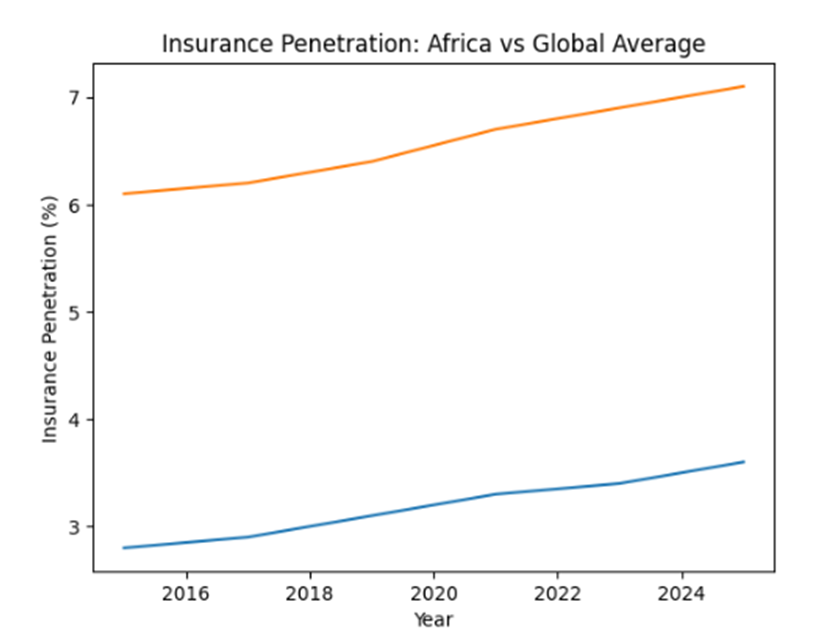
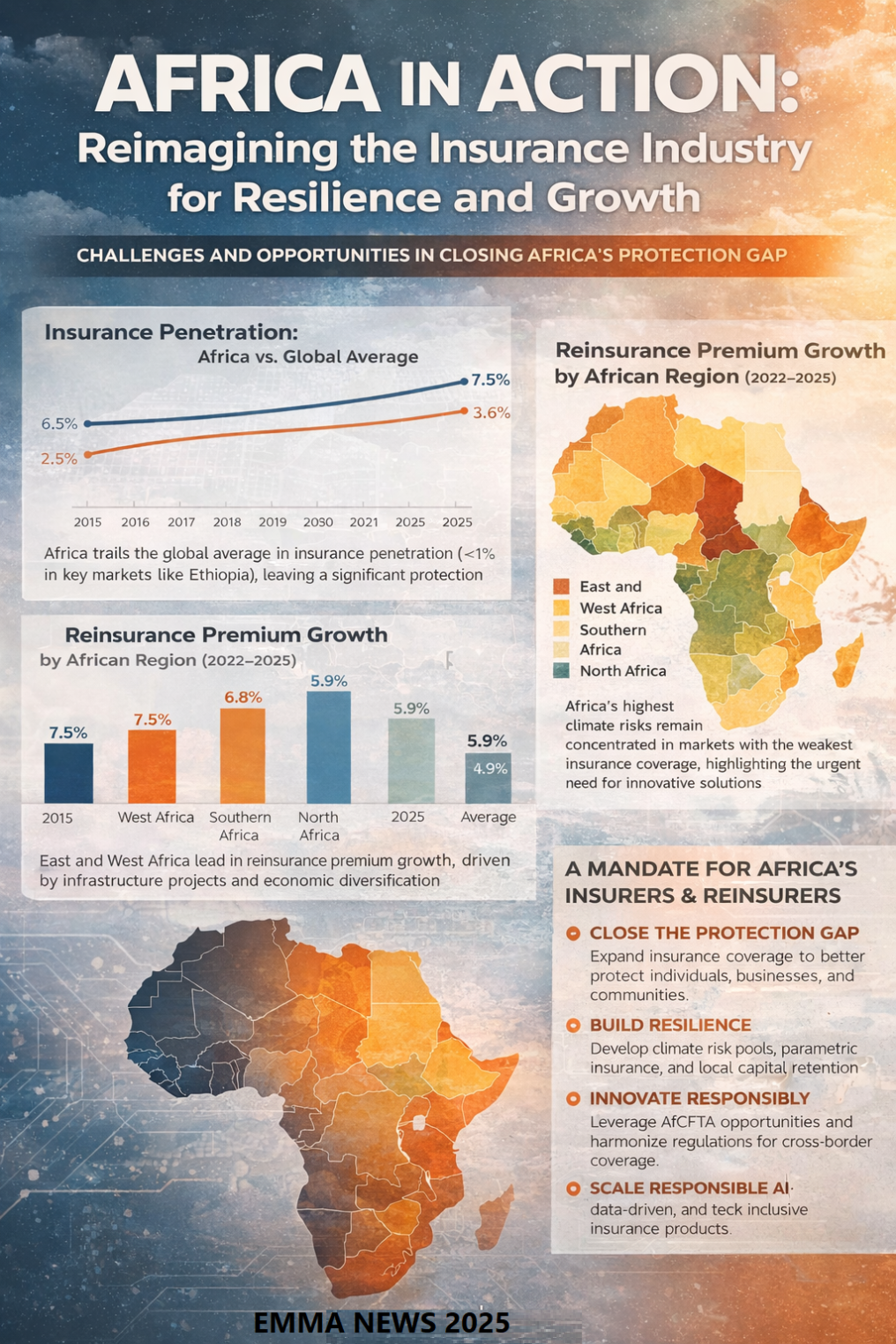
Insurance penetration in Africa continues to trail global averages, highlighting a persistent protection gap despite gradual market growth. Industry leaders argue that reinsurance capacity is key to accelerating inclusive coverage.
This line chart illustrates how Africa’s insurance penetration has risen slowly from around 2.8% to about 3.6% over a decade, while the global average continues to accelerate beyond 7%. The widening gap visually reinforces the central argument of your story: growth exists, but inclusion lags behind exposure.
The rising columns on the page ultimately reflect a continent at a crossroads. Africa’s reinsurance industry is growing, but growth alone will not insure the future. The real test lies in whether this expansion translates into broader risk protection, deeper resilience, and stronger confidence across societies, not just balance sheets. As the voices from Addis Ababa made clear, Africa’s risk story is being rewritten, and reinsurance will determine whether it becomes a story of vulnerability managed or opportunity secured.
The 10th Continental Reinsurance CEO Summit discussions made clear that while Africa’s insurance market is growing, its reinsurance backbone remains under strain. According to the Swiss Re Institute’s Africa-focused sigma analyses, insurance penetration across most African markets remains below one percent of GDP, compared to a global average exceeding six percent. This gap, Patty Karuaihe Martin – President of AIO, argued, is not merely a market failure but a reflection of historical underinvestment in data, actuarial capacity, and risk pooling mechanisms. “Without strong reinsurance, primary insurance markets cannot scale sustainably,” noted a senior industry participant during the sessions, a view widely shared by Africa Re and Continental Re in their continental outlooks.
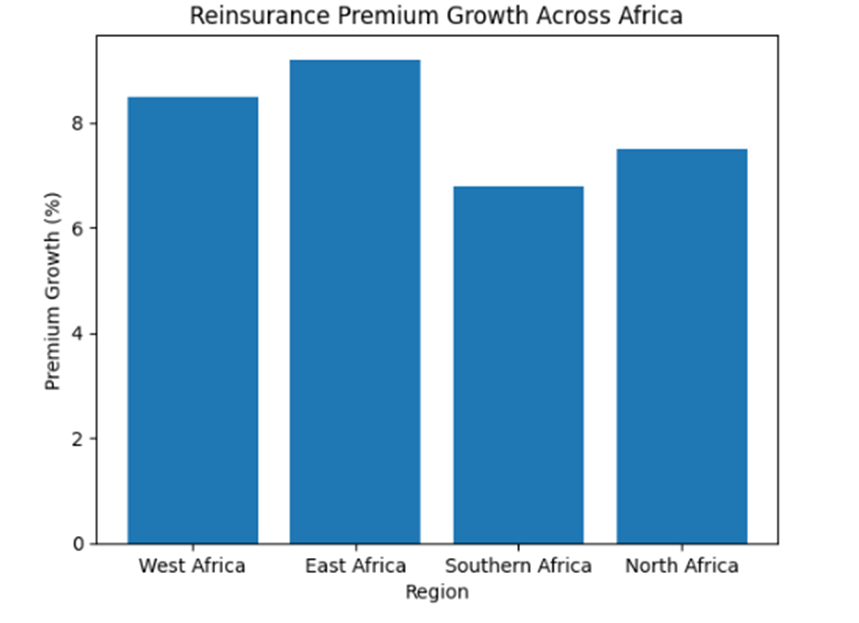
Reinsurance premium growth across Africa remains uneven, reflecting differences in infrastructure investment, regulatory maturity, and local capital capacity.
This bar chart compares reinsurance premium growth across African regions, with East and West Africa leading, while Southern and North Africa show steadier but slower expansion. The visual supports the current African analysis of uneven market development.
Regulatory reform emerged as a central theme, not as bureaucratic housekeeping but as the foundation for trust and capital mobilization. Salomon Desta, Vice Governor of the National Bank of Ethiopia, speaking in his official capacity, described Africa’s shift toward risk-based supervision as a turning point. He highlighted reforms underway to strengthen capital adequacy, governance, and reporting standards, aligning the country with emerging African best practices. His comments mirrored broader continental movements documented by the African Insurance Organisation (AIO), which has consistently argued that weak regulatory harmonization remains one of the biggest bottlenecks to cross-border reinsurance growth. “Risk-based capital is not about compliance alone,” Desta stressed, “it is about protecting policyholders and ensuring that insurers and reinsurers can withstand systemic shocks.”
That emphasis on resilience resonated strongly with reinsurance analysts. In its most recent Africa market review, Swiss Re Africa notes that climate-related losses on the continent are rising faster than premium growth, creating an urgent need for parametric insurance, sovereign risk pools, and stronger retrocession frameworks. These insights found practical expression in the Addis conversations, where speakers discussed agricultural insurance, climate risk transfer, and disaster financing not as pilot projects, but as scalable continental solutions. “Africa cannot insure yesterday’s risks with yesterday’s tools,” remarked one technical expert during the sessions, echoing research by Cenfri, which identifies innovation-regulation alignment as the key determinant of insurance uptake in emerging markets.
The industry’s internal weaknesses were not ignored. In unusually candid exchanges captured in the transcript, industry leaders acknowledged destructive price competition, weak data sharing, and an overconcentration on motor insurance. Mr Yared Mola, President of the Association of Ethiopian Insurers and a senior voice within the AIO, warned that underpricing and fragmented competition threaten the solvency of insurers and the confidence of reinsurers. His critique aligns with findings from Deloitte’s East Africa Insurance Outlook, which cautions that without pricing discipline and actuarial rigor, premium growth can mask deep structural fragility. Reinsurers, he argued, must become partners in discipline and innovation, not merely balance-sheet backstops.
Yet, amid the risks, opportunity dominated the narrative. Africa’s demographic dividend, rapid digitalization, and expanding infrastructure pipeline present unprecedented openings for reinsurance-led growth. According to the AIO Insurance Pulse Report, Africa’s reinsurance premiums have outpaced global averages in recent years, driven by infrastructure projects, energy investments, and sovereign risk covers. Participants in Addis emphasized that this momentum must now be matched with continental collaboration shared data platforms, regional catastrophe models, and coordinated regulatory frameworks. “Reinsurance is where Africa’s collective strength can truly materialize,” observed a regional analyst, reflecting a view widely supported in Continental Re’s own market commentaries.
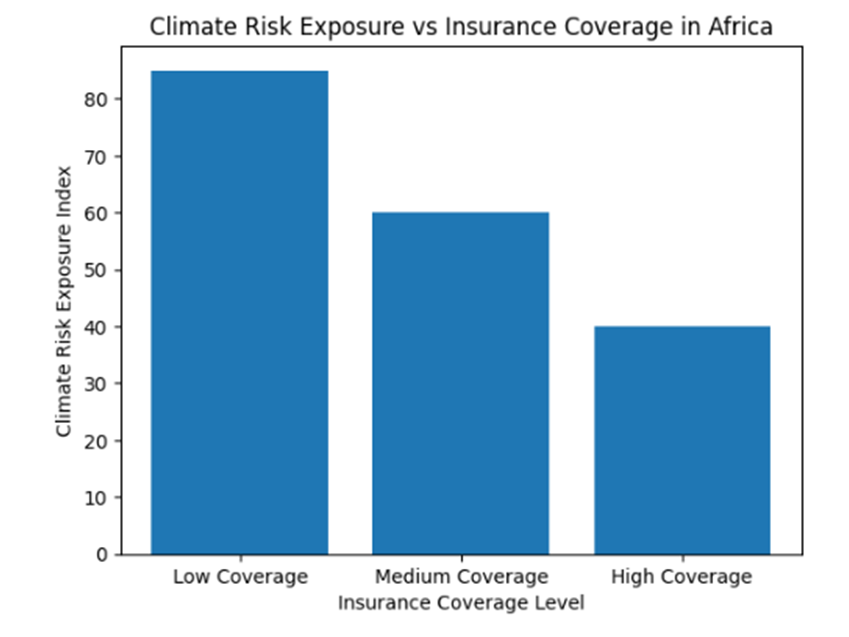
Africa’s highest climate risks remain concentrated in markets with the weakest insurance coverage, intensifying the urgency for parametric insurance and regional risk pools.
This chart starkly illustrates that countries with the lowest insurance coverage face the highest climate risk exposure, underlining why reinsurers are central to Africa’s climate resilience agenda.
Technology and talent surfaced as decisive enablers of this future. InsurTech demonstrations and discussions highlighted how digital underwriting, satellite data, and AI-driven risk assessment could finally unlock underserved markets. These themes align closely with World Bank and IFC research, which identifies digital insurance as one of the fastest pathways to financial inclusion in low-income economies. But speakers were equally clear that technology without human capacity is hollow. Investments in actuarial science, claims management, and regulatory skills were repeatedly described as non-negotiable. As one participant put it, “Africa does not suffer from a lack of ideas; it suffers from a shortage of scaled expertise.”
What ultimately distinguished the Addis gathering and what elevates this story into award-worthy territory was its Pan-African consciousness. This was not a national conversation framed inwardly, but a continental dialogue outwardly connected to global markets. From references to Kenya’s regulatory reforms and Rwanda’s insurance innovation, to lessons drawn from Nigeria and South Africa, the discussions reflected a shared understanding: Africa’s risk future is interlinked. The African Union’s Agenda 2063, which identifies risk financing as central to sustainable development, hovered implicitly over the conversations, reinforcing the idea that insurance and reinsurance are now strategic instruments of continental policy.
In the end, what emerged from the transcript is not just a conference record, but a moment of narrative shift. Africa’s reinsurance industry is no longer content to be reactive, peripheral, or externally defined. It is asserting its voice, confronting its gaps, and articulating its ambitions with clarity. As climate volatility intensifies and global capital becomes more risk-averse, Africa’s ability to tell and insure its own risk story may well determine its economic trajectory.
This is why the voices captured here matter. They are not merely speaking to each other, but to the continent and the world. And they are saying, with growing confidence, that Africa’s risk story is no longer about exposure alone; it is about resilience, partnership, and possibility.
The rising Reinsurance columns on the African insurance industry ultimately reflect a continent at a crossroads. Africa’s reinsurance industry is growing, but growth alone will not insure the future. The real test lies in whether this expansion translates into broader risk protection, deeper resilience, and stronger confidence across societies, not just balance sheets. As the voices from Addis Ababa made clear, Africa’s risk story is being rewritten, and reinsurance will determine whether it becomes a story of vulnerability managed or opportunity secured.
A Turning Point for Africa’s Risk Story
As Continental Re marked forty years of operations, Mutsunge Lawrence Nazare, Group Managing Director of Continental Reinsurance, emphasized the evolution of African reinsurance from fragmented beginnings into a sector increasingly central to economic stability and development financing.
“Our success over the past four decades is rooted in strong partnerships and shared trust,” Nazare noted. “This journey belongs not only to Continental Re, but to our employees, clients, regulators, and stakeholders who have helped shape Africa’s reinsurance ecosystem.”
Regulatory collaboration featured prominently throughout the Summit, with leaders underscoring the role of supervision in sustaining market confidence. Segun Omosehin, Commissioner for Insurance at Nigeria’s National Insurance Commission (NAICOM), stressed that regulation must evolve in tandem with growing and more complex risks.
“Effective regulation is not about restriction; it is about creating a stable environment where insurers and reinsurers can innovate responsibly,” Omosehin said. “Collaboration between regulators and industry players is essential if African markets are to remain solvent, trusted, and globally competitive.”
The future of leadership in a rapidly digitising insurance environment was addressed in a keynote that resonated widely across the audience. William Mzimba, former Chief Executive Officer of Accenture and Vodacom Business, challenged industry executives to rethink leadership beyond technology adoption.
“Innovation without empathy creates efficiency, but not sustainability,” Mzimba observed. “As automation and artificial intelligence reshape insurance, leaders must balance technological advancement with human judgment, ethics, and accountability.”
“Markets are evolving faster than ever before,” said Kiptum Godfrey, Kenya’s Commissioner of Insurance. “Regulatory systems must be equally adaptive if they are to support growth without compromising stability.”
“Strong supervision is the backbone of trust,” added Al Hajj Ibrahim Lubega Kaddunnabi, Chief Executive Officer of Uganda’s Insurance Regulatory Authority. “Without it, innovation risks outpacing responsibility.”
Innovation and Collaboration: Beyond Borders
“The African insurance story is no longer national; it is regional,” noted Dr. Grace Muradzikwa, Commissioner of Insurance for Zimbabwe. “Cross-border cooperation among regulators is now a necessity, not an option.”
Technical discussions with experts focused on the intersection of capital adequacy and emerging technologies. A dedicated session on Risk-Based Capital (RBC) modeling and Artificial Intelligence highlighted how data-driven tools are transforming underwriting and capital management, while also exposing new governance challenges.
“AI can significantly enhance decision-making, but only if it understands the data and the context in which it operates,” said David Kirk of Milliman. “In insurance, poorly governed AI systems can amplify risk rather than reduce it.”
“Risk-based capital frameworks provide the discipline that modern insurance markets require,” said Jooste Steynberg of the Prudential Authority, “but these frameworks must be supported by sound data, actuarial capacity, and regulatory oversight.”
From an industry perspective, Cedric Maxwell of Continental Reinsurance emphasized that innovation must be accompanied by responsibility.
“If AI tools cannot adapt across diverse datasets and environments, we must acknowledge their limitations,” Maxwell said. “Responsible governance ensures that technology strengthens, rather than undermines, trust in our industry.”
The overarching message was one of cautious optimism. Africa’s reinsurance market is expanding, driven by infrastructure development, climate exposure, and economic diversification. Yet experts repeatedly warned that growth without discipline could expose systemic weaknesses.
“The next phase of Africa’s reinsurance journey must be defined by resilience, collaboration, and ethical innovation,” Nazare concluded. “As we look toward the future, our commitment is to build an industry that not only absorbs risk but enables sustainable development across the continent.”
From Dialogue to Delivery: What “Africa in Action” Means for Continental Reinsurance
At the 10th Continental Reinsurance CEO Summit and the company’s 40th anniversary celebrations in Cape Town, one phrase emerged as more than a slogan. “Africa in Action” crystallized the collective mood of the gathering, a decisive shift from extended dialogue to concrete implementation across Africa’s reinsurance landscape.
For Continental Reinsurance, the phrase signals a turning point. It represents a move beyond conferences and communiqués toward measurable action in markets where risk is rising faster than coverage. Industry leaders at the Summit agreed that Africa can no longer afford incremental responses to systemic challenges. Economic volatility, climate shocks, and geopolitical uncertainty are redefining the risk environment, demanding solutions that are both locally grounded and continentally coordinated.
At the core of this call is ownership. Speakers repeatedly emphasized that Africa’s insurance and reinsurance future cannot be externally designed. Instead, it must be shaped by African institutions with deep market knowledge, long-term commitment, and the capacity to innovate responsibly. This approach places reinsurance at the center of Africa’s resilience agenda, not as a secondary financial service, but as a strategic instrument for economic stability and development.
“Africa must define its own path forward, and Continental Reinsurance is committed to leading by example,” said Mutsunge Lawrence Nazare, Group Managing Director of Continental Re Holdings. “Our journey continues as we strengthen our African identity and ensure that we serve our clients and partners with solutions designed for the realities they face.”
The implications of this shift are significant. Closing Africa’s vast protection gap remains one of the industry’s most urgent priorities, as insurance penetration across much of the continent remains among the lowest globally. Leaders at the Summit argued that without decisive intervention, uninsured losses will continue to undermine household security, business continuity, and public finances. Reinsurance, they noted, has a critical role to play in enabling insurers to expand coverage without compromising solvency.
Equally important is the task of building resilience within African economies. Climate risk, in particular, has elevated the need for innovative risk transfer mechanisms, including parametric insurance, regional catastrophe pools, and sovereign risk solutions. These tools, participants argued, must be scaled through strong local reinsurance capacity to ensure that more risk and more capital are retained within the continent.
The African Continental Free Trade Area (AfCFTA) featured prominently in the closing discussions as both an opportunity and a test. A truly integrated African market, speakers observed, will require cross-border risk solutions supported by regulatory cooperation and harmonized standards. For reinsurers, this integration offers the chance to support trade, infrastructure, and investment at an unprecedented scale, provided collaboration replaces fragmentation.
Another recurring theme was capital retention. Industry leaders stressed that Africa must reduce its dependence on offshore reinsurance by strengthening local capital formation and regional risk pooling. Retaining more premiums within Africa, they argued, would not only deepen markets but also enhance the continent’s ability to absorb shocks independently.
The African Re message was clear: “Africa in Action” is not aspirational rhetoric; it is an operational mandate. It challenges reinsurers, regulators, and policymakers to convert insight into execution and ambition into impact.
For Continental Reinsurance, this mandate aligns seamlessly with its four-decade legacy. The company’s leadership reiterated that the next phase of its journey will be defined by purposeful growth, responsible innovation, and deeper partnerships across Africa’s insurance ecosystem.
In an industry often criticized for moving cautiously, the tone in Cape Town was unmistakably urgent. Africa’s risks are evolving, and so must its solutions. The era of conversation is giving way to the era of delivery, and for African reinsurance, the work is only just beginning.
በኢትዮጵያ ሕጋዊ ነዋሪ ለሆኑ ሁሉ ይሰጣል የተባለው ዲጂታል መታወቂያ ምንድን ነው?
#DPIJournalism #DPIFellows2025 For the CIPESA DPI Journalism Fellowship, Eastern Africa By Ayele Addis DPI Journalism Fellowship for Eastern Africa ኢትዮጵያ የዲጂታል ኢትዮጵያ 2025 ስትራቴጂን ቀርፃና አፅድቃ ወደ ሥራ ከገባች ሰነባብታለች። ዲጂታል ኢትዮጵያ የዲጂታል ቴክኖሎጂ ዕድሎችን በመጠቀም ፈጠራ የታከለበትና በእውቀት ላይ የተመሰረተ ኢኮኖሚ ለመገንባት የሚያስችል በኢትዮጵያ መንግሥት የሚመራ ተነሳሽነት ነው። የዲጂታል ቴክኖሎጂ ሽግግር በአካል ከሚደረጉ ግንኙነቶች […]