
By Amisale Genet Demelew
EMMA NEWS – Ethiopian Mass Media
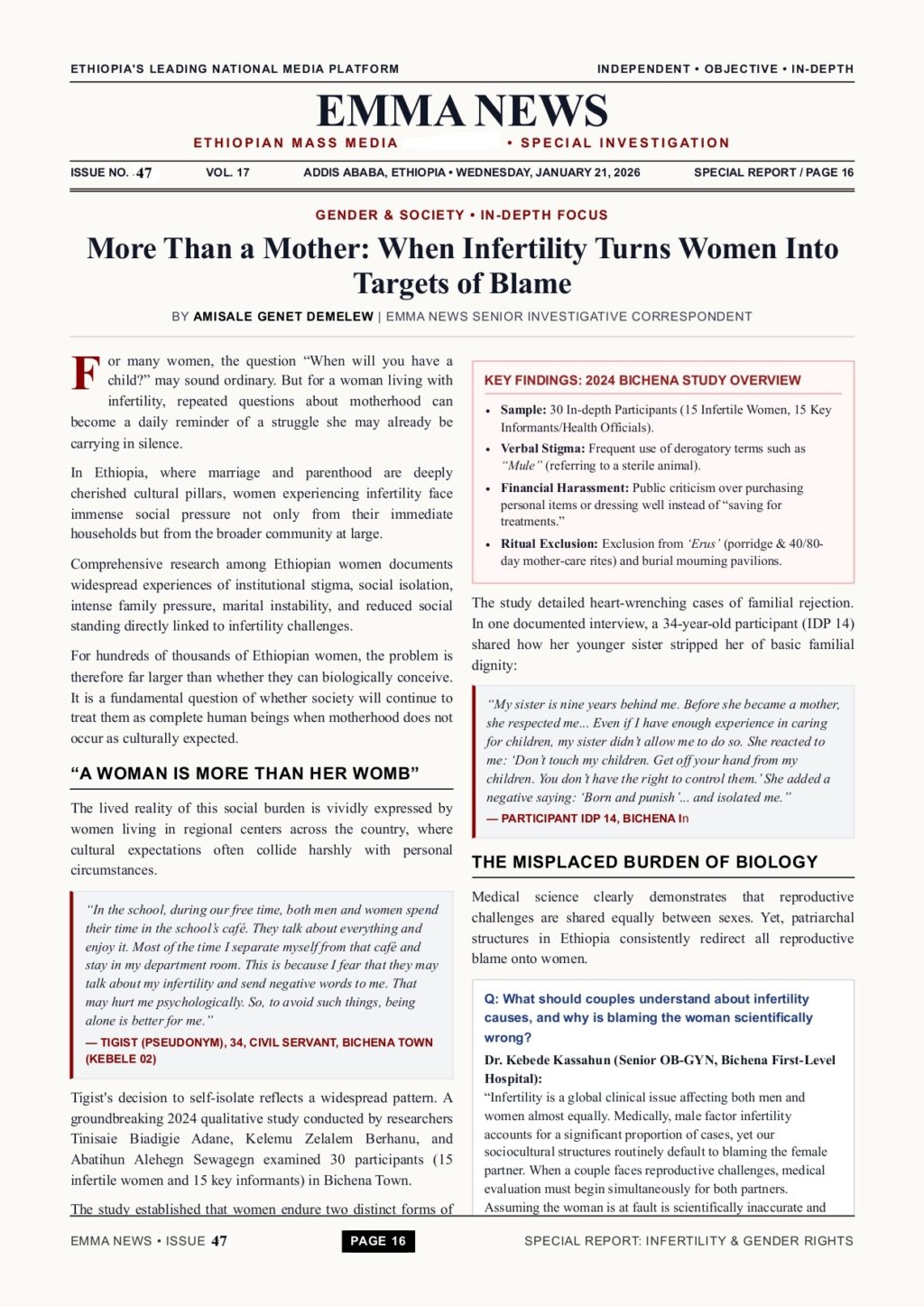
ADDIS ABABA, ETHIOPIA — For many women, the question “When will you have a child?” may sound ordinary. But for a woman living with infertility, repeated questions about motherhood can become a daily reminder of a struggle she may already be carrying in silence.
In Ethiopia, where marriage and parenthood are highly valued, women experiencing infertility can face pressure not only from their immediate families but also from the wider community. Research among Ethiopian women has documented experiences of stigma, isolation, family pressure, marital instability, and reduced social status associated with infertility.
For some women, the problem is therefore not only whether they can conceive. It is whether society will continue to see them as complete human beings when motherhood does not come as expected.
“A woman is more than her ability to give birth”
[VOICE FROM BICHENA]
Interviewee: Tigist (Pseudonym), 34, Civil Servant & Resident of Bichena Town, Kebele 02
“In the school, during our free time, both men and women have spent their time in the school’s café. They talk everything which creates fun and enjoy that. Most of the time I separate myself from that café and stay in my department room. This is because I fear that they may talk about my infertility and may send negative words to me. That may hurt me psychologically. So, to avoid such things, being alone is better for me.”
The woman interviewed by EMMA NEWS describes how conversations about children gradually changed the way she interacted with relatives, neighbours, and friends.
Her experience reflects a wider problem documented by researchers studying infertility in Ethiopia: women may experience social isolation and pressure alongside the medical and financial difficulties of seeking treatment. A 2024 qualitative study conducted by Tinisaie Biadigie Adane, Kelemu Zelalem Berhanu, and Abatihun Alehegn Sewagegn involving 30 participants (15 infertile women and 15 key informants) in Bichena Town found that stigma, family and social pressure, isolation, and marital instability were among the major challenges reported by participants.
The Bichena interviewee detailed how women face two distinct forms of isolation: self-isolation (withdrawing to avoid harsh judgment) and social isolation imposed by relatives, neighbours, and colleagues. In one illustrative case from the study, a participant shared the painful exclusion she faced from her own family:
“My sister is nine years behind me. Before she became a mother, she respected me… Even if I have enough experience in caring for children, my sister didn’t allow me to do so. She reacted to me as ‘don’t touch my children. Get off your hand from my children. You don’t have the right to control them’. She also added a negative saying ‘Born and punish’… and isolate me.” Bichena interviewee
Another study involving women receiving infertility treatment in public hospitals in Addis Ababa identified themes including financial sacrifice, marriage strain, social estrangement, psychological distress, faith, and resilience.
The blame does not always follow the biology
Infertility is not simply a “women’s problem”. Yet cultural expectations can place a disproportionate burden on women.
[EXPERT INSIGHT]
Interviewee: Dr. Kebede Kassahun, Senior Obstetrician-Gynecologist & Reproductive Health Specialist, Bichena First-Level Hospital
Question: “What should couples understand about the causes of infertility, and why is it medically inappropriate to automatically blame the woman?”
Dr. Kebede Kassahun: “Infertility is a global clinical issue affecting both men and women almost equally. Medically, male factor infertility accounts for a significant proportion of cases, yet our sociocultural structures routinely default to blaming the female partner. When a couple faces reproductive challenges, medical evaluation must begin simultaneously for both partners. Automatically assuming the woman is at fault is scientifically inaccurate and causes profound, unnecessary psychological trauma.”
Research conducted in Addis Ababa and regional towns has noted that although infertility affects both sexes, social blame and stigma are overwhelmingly directed toward women. The 2024 Bichena study revealed that women are frequently subjected to severe verbal stigma, such as being labeled as a “Mule” referring to the sterile animal or facing derogatory comments regarding their dressing style, where wearing new clothes is met with criticisms like: “instead of dressing different fashioned clothes everyday, worry for your problems and give children to your husband.”
Changing the infertility conversation requires more than expanding medical services. It requires changing the social question from “What is wrong with the woman?” to “What support does this couple need?”
The hidden cost of stigma
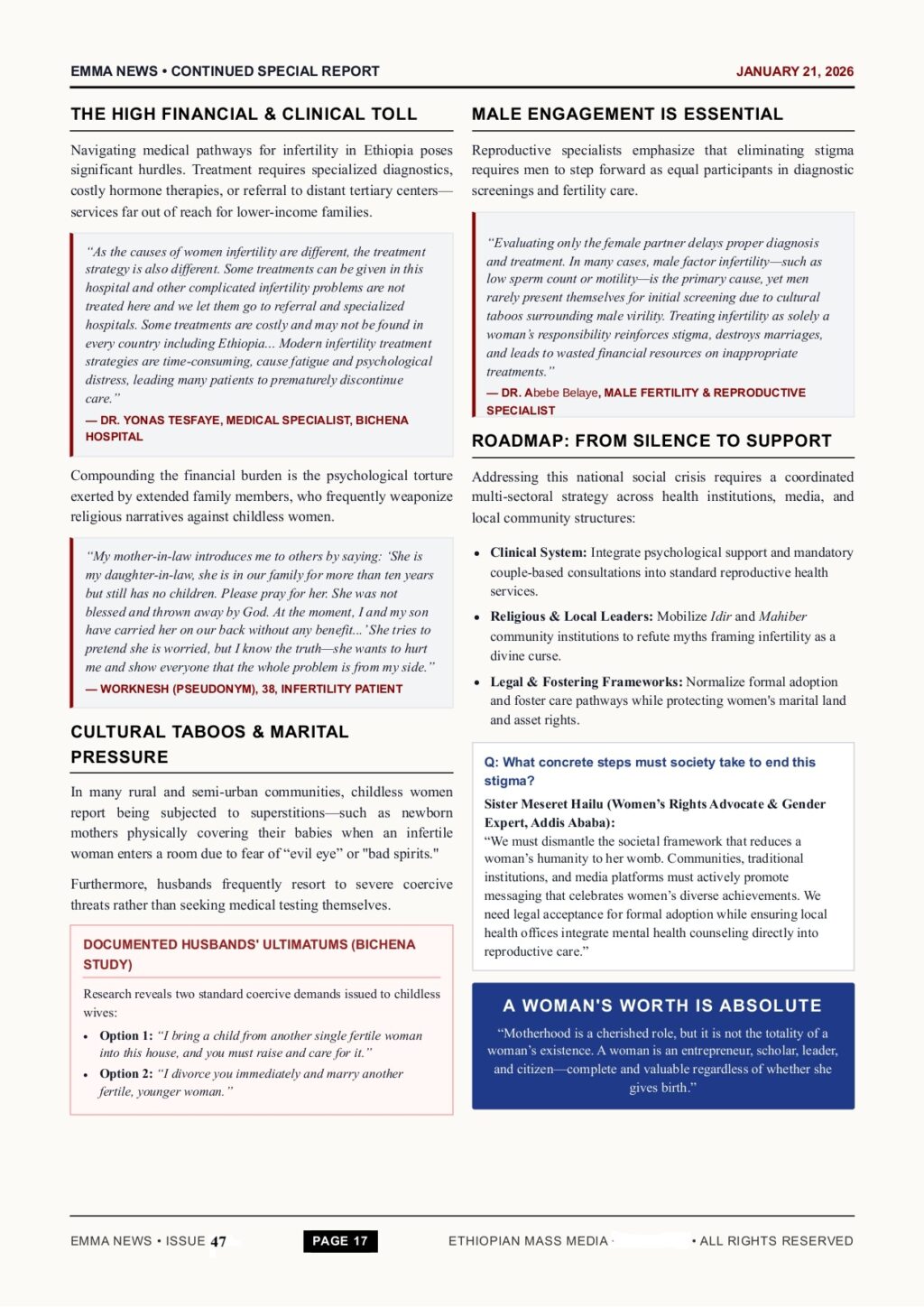
Seeking infertility treatment can itself be difficult. Treatment may require repeated medical consultations, diagnostic procedures, medication, and financial resources. For families with limited income, the financial burden can become another source of stress.
[CLINICAL & TREATMENT PERSPECTIVE]
Interviewee: Dr. Yonas Tesfaye, Medical Specialist, Bichena Hospital
“As the causes of women infertility are different, the treatment strategy is also different. Some treatments can be given in this hospital and other complicated infertility problems are not treated here and we let them to go to other referral and specialized hospitals. Some treatments are costly and may not be found in every country including Ethiopia… In addition to the expensiveness of some modern infertility treatment strategies, they are time-consuming and cause fatigue and psychological distress, leading many patients to prematurely discontinue medical care.”
But women interviewed for this story say the emotional cost can be equally difficult.
[PATIENT TESTIMONY]
Interviewee: Worknesh (Pseudonym), Experience Infertility
“My mother-in-law introduces me to others by saying: ‘she is my daughter-in-law, she is in our family for more than ten years but still has no children. Please pray for her. She was not blessed and thrown away by God. At the moment, I and my son have carried her on our back without any benefit…’ She tries to pretend she is worried, but I know the truth, she wants to hurt me and show everyone that the whole problem is from my side.”
Researchers studying infertile Ethiopian women have reported experiences of ostracization and social exclusion, showing that infertility affects social relationships far beyond the clinic. In Bichena, cultural challenges extend to missing out on essential social rituals, such as the porridge preparation and 40/80-day mother-care rituals (‘Erus’), burial rites where childless individuals face the fear of an empty mourning pavilion, and the painful practice where newborn mothers cover their infants when an infertile woman enters the house out of fear of “bad spirits”.
Men must be part of the conversation
Health professionals interviewed for this story emphasize why infertility assessments must involve both partners.
[SPECIALIST QUOTE]
Interviewee: Dr. Abebe Belay, Male Fertility & Reproductive Health Specialist
“Evaluating only the female partner delays proper diagnosis and treatment. In many cases, male factor infertility—such as low sperm count or motility is the primary cause, yet men rarely present themselves for initial screening due to cultural taboos surrounding male virility. Treating infertility as solely a woman’s responsibility reinforces stigma, destroys marriages, and leads to wasted financial resources on inappropriate treatments.”
This is crucial because treating infertility as a woman’s responsibility delays appropriate assessment and reinforces stigma. As documented in the 2024 study, many husbands exert severe marital pressure, offering Ultimatums: “I don’t continue without having children. So, I have two options for you; one, can I bring a child from other fertile single women to this house and could you care? Two can I divorce you and marry another fertile and beautiful woman?”
A couple seeking help should therefore be treated as a couple not as a woman who has “failed” to become a mother.
From silence to support
Changing attitudes does not necessarily require complicated solutions.
- Health professionals can provide accurate diagnostic information and couples-based counseling.
- Religious and community leaders can challenge harmful stereotypes, offering spiritual comfort without framing childlessness as a divine curse.
- Families can replace blame and pressure with emotional and financial support.
- Media organizations can stop portraying motherhood as the ultimate or sole measure of a woman’s worth.
[GENDER & RIGHTS PERSPECTIVE]
Interviewee: Sister Meseret Hailu, Women’s Rights Advocate & Gender Expert, Addis Ababa
Question: “What can families, communities, and the media do to reduce infertility stigma?”
Sister Meseret Hailu: “We must dismantle the societal framework that reduces a woman’s humanity to her womb. Communities, traditional institutions like Idir and Mahiber, and media platforms must actively promote messaging that celebrates women’s diverse achievements. We need legal and social acceptance for formal adoption and fostering options, while ensuring that local health offices integrate psychological counseling directly into reproductive health services.”
The answer may begin with something simple: stop asking a woman to prove her worth through motherhood.
More than a mother
Motherhood can be an important part of a woman’s life, but it should not become the definition of her entire identity.
A woman can be a professional, entrepreneur, daughter, sister, friend, community leader, and citizen—and she remains all of those things whether or not she has children.
For women living with infertility, the most important message may therefore be one that society rarely says loudly enough:
Your worth is not determined by your ability to give birth.
Breaking infertility stigma requires medical care, accurate information, and social change. Most importantly, it requires seeing women as whole human beings rather than defining them by whether they have become mothers.
EMMA NEWS — Ethiopian Mass Media Authority Publication
Issue No. 564 | Vol. 17 | January 21, 2026 | Page 16

በፈጠራ ስራዎ ልንሸልምዎ እና አጋር የሚዲያ አባል ልናደርግዎ ነው፡፡ @PulitzerCenter
በፈጠራ ስራዎ ልንሸልምዎ እና አጋር የሚዲያ አባል ልናደርግዎ ነው፡፡ ይምጡ በሰሩት አንድ ደቂቃ እና ከዛ ባላይ በሆነ የፈጠራ መልዕክት እንሸልምዎት ፣ በአባይ ጉዳይ እና የኢትዮጵያን መልካም ገፅታ ለማስተዋወቅ በፈለጉት የቲክቶክ አካውንት ፣ ፊስ ቡክ ፣ ኢንስታግራም ማህበራዊ ሚዲያዎች ተከታታይ መልዕክቶችን ስለአባይ ወንዛችን በፈለጉት አቀራረብ ፣ ስለ አባይ ውሃ፣ የአባይ ወንዝ የውሃ ፍትሃዊ አጠቃቀም ፣ በግጥም […]