
By Amisale Genet & Meselch Zelalem | Ethiopian Mass Media (EMMA NEWS)
“They told us development was coming. Instead, our land disappeared.”
The old man points toward a stretch of land that once held sorghum fields, grazing grounds, and ancestral burial sites. Today, the horizon is dominated by commercial farms, fenced boundaries, and machinery that rarely employs the people who once lived there.
“We were told investors would bring jobs,” he says quietly. “But first they took the land.”
Across Ethiopia’s fertile lowlands, from Gambella to Oromia and Amhara, stories like his have become part of a larger and increasingly controversial development model, one that promises growth through foreign investment while leaving behind difficult questions about land rights, displacement, environmental destruction, and who ultimately benefits.
For more than a decade, Ethiopia has aggressively marketed millions of hectares of agricultural land to investors under a strategy aimed at transforming the economy through commercial agriculture. Government officials described these lands as “underutilized” and available for modernization. Yet reports from affected communities, human-rights organizations, environmental researchers, and development institutions reveal another reality: a system where communities often bear the costs while political and corporate actors capture the gains.
The result is an example of what Center for International Private Enterprise (CIPE) increasingly describes as corrosive capital, at a guide for investigative journalists to identify and track foreign investments that weaken a country’s democratic institutions and values. Corrosive capital describes financing, whether state or private, that lacks transparency, accountability, and market orientation. An investment that weakens transparency, undermines accountability, extracts local resources, and leaves social and environmental damage in its wake.
The Billion-Dollar Promise
Beginning in the late 2000s, Ethiopia emerged as one of Africa’s most attractive destinations for agricultural foreign direct investment.
Large-scale land leases were awarded to investors from India, Saudi Arabia, China, and other countries seeking farmland, food security, and export opportunities.
According to investigations by Human Rights Watch, between 2008 and 2011 alone, Ethiopia leased at least 3.6 million hectares of land, an area roughly equivalent to the size of the Netherlands. An additional 2.1 million hectares were reportedly placed in a federal “land bank” for future agricultural investment.
The government framed the initiative as a development breakthrough. Investors would bring technology, jobs, infrastructure, export earnings, and modernization to remote regions.
Yet years later, many of those promises remain disputed.
The Disappearing Villages of Gambella
The most controversial chapter unfolded in Gambella. One of the most important documents is the Land Rent Contractual Agreement between Ethiopia’s Ministry of Agriculture and Rural Development and Karuturi Agro Products PLC and Saudi Star agricultural project one of the largest foreign agricultural investors in Gambella. The lease agreement states that Karuturi sought extensive land for palm plantations, maize, and rice production in the Gambella region. The contract was negotiated through federal authorities and regional government structures.
Contract records reviewed by journalists indicate that many land agreements followed standardized templates and were negotiated with limited public transparency. While investors received extensive access to land and development rights, affected communities frequently reported that they were never consulted before decisions were finalized. Critics argue that this imbalance lies at the heart of Ethiopia’s corrosive-capital dilemma: communities assume the social and environmental risks while investors and political actors retain the greatest decision-making power.
In 2010, the government launched a villagization program intended, according to official statements, to improve access to education, healthcare, roads, and water services.
However, investigations by Human Rights Watch documented extensive allegations that communities were relocated against their will and that many of the lands they left behind were later earmarked for commercial agriculture.
Our investigative team also interviewed residents who reported threats, intimidation, arrests, and pressure to relocate. Multiple witnesses said officials openly linked relocation efforts to incoming agricultural investors.
One resident recalled officials telling villagers:
“We will invite investors who will grow cash crops. You do not use the land well. It is lying idle.”
Satellite analysis conducted by the American Association for the Advancement of Science (AAAS) later found evidence consistent with village destruction, relocation, and the expansion of commercial farming operations in Gambella.
For communities dependent on rivers, forests, and shifting cultivation systems, relocation was not simply a change of address. It represented the collapse of an entire economic and cultural system.
Oromia’s New Frontier
In Oromia, Ethiopia’s largest and most populous region, tensions over land and mine investment have become increasingly tied to mining, commercial agriculture, urban expansion, industrial parks, and investment corridors.
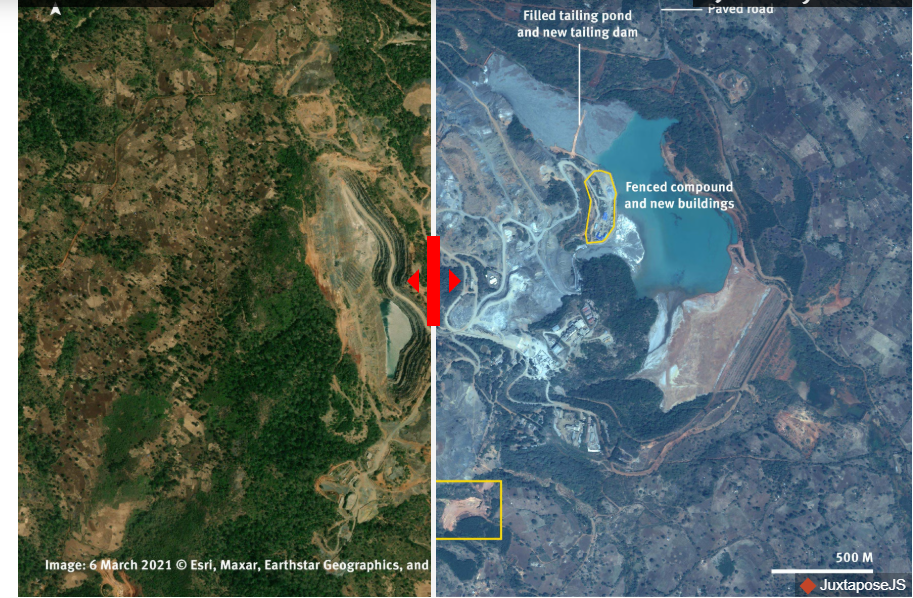
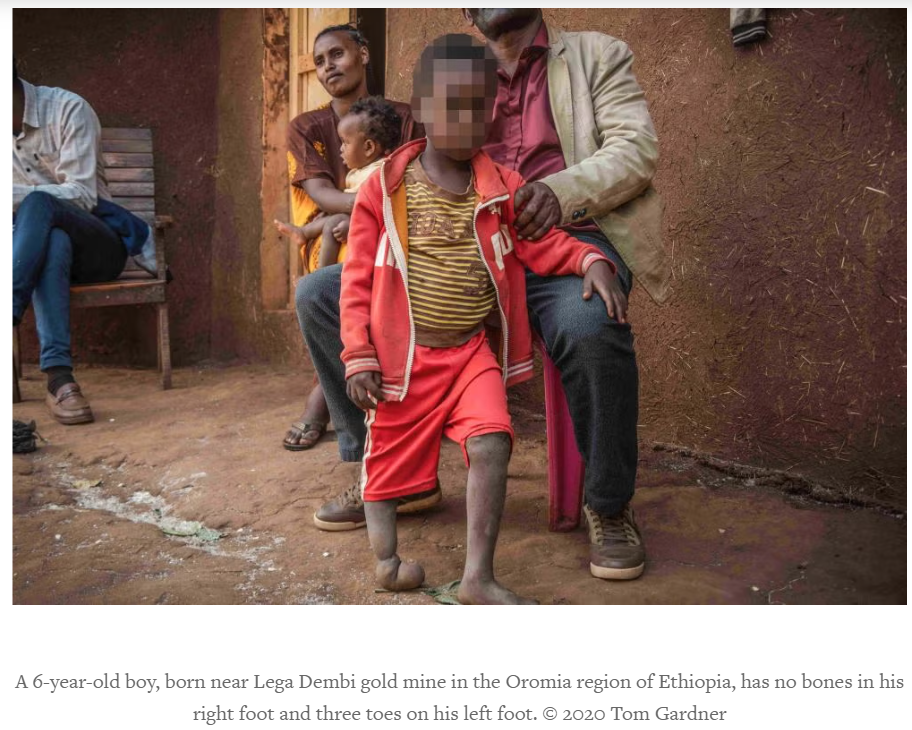
The investment company operating the Lega Dembi gold mine, Argor-Heraeus, the Swiss refinery, and Midroc Investment Group that sourced its gold, took no action despite media reports about pollution from the mine. Environmental testing by Addis Ababa University in 2018 found high levels of arsenic in water samples taken downstream from the mine area, and high levels of nickel, chromium, and arsenic in soil samples outside the mine.
People living near Lega Dembi gold mine in Ethiopia’s Oromia region have for years complained about serious health impacts, including children born with long-term health conditions, miscarriages, and stillbirths.
Researchers Hailemariam Meaza interviewed by local journalists and civil-society organizations frequently describe uncertainty over land tenure, compensation disputes, and fears that development projects may arrive without meaningful consultation. Mr Hailemairam Underscore the growing illegal and lawless gold mining practices were critically degrading the multifunctional landscapes.
In person discussions among Ethiopian farmers and investors increasingly reflect concerns over land security, expropriation risks, and weak legal protections, highlighting widespread public anxiety surrounding rural land rights and investment governance (Reddit discussion on Ethiopian land leasing).
While some projects have generated infrastructure improvements and local economic activity, critics argue that compensation mechanisms remain inconsistent and often fail to account for long-term livelihood losses.
When satellite imagery is examined alongside publicly available lease agreements, a consistent pattern emerges.
Large-scale investment projects often appear in areas where:
- Forest cover declined rapidly;
- Grasslands were converted into farmland;
- Indigenous land-use systems were disrupted;
- Infrastructure expansion followed land allocation;
- Communities reported displacement or reduced access to natural resources.
Key quantitative findings supported by satellite and land-cover research include:
- 599 km² increase in agricultural land (2000–2017). Large-scale commercial farming expanded to roughly 746 km² by 2017.
- 42% of Gambella land marketed or allocated to investors during the villagization era, according to AAAS reporting.
- 2004–2024 satellite monitoring shows accelerating forest loss and declining vegetation health linked to agricultural expansion.
These figures provide the strongest empirical backbone for framing the investigation around land transformation, displacement risk, environmental degradation, and corrosive capital.
@Tom Gardner
Corrosive Capital: When Investment Extracts More Than It Builds
According to Daniel Figueroa from University of Sussex and Isabelle McRae “Corrosive capital is not defined by foreign ownership alone. It refers to investment that flourishes in environments with weak transparency, limited oversight, political favoritism, and insufficient accountability.”
The warning signs are visible throughout numerous Ethiopian land deals over the past fifteen years:
- Communities often lack access to lease agreements.
- Compensation processes remain opaque.
- Environmental monitoring is inconsistent.
- Local consultation is frequently disputed.
- Benefits are concentrated among political and economic elites.
In such environments, investment can become extractive rather than developmental.
The pattern is familiar across many resource-rich regions globally: land becomes a commodity, local communities become obstacles, and environmental costs are treated as externalities.
The Environmental Bill Arrives
The ecological consequences may outlast the investment contracts themselves.
Environmental researchers have repeatedly warned that large-scale agricultural projects can accelerate:
- Deforestation
- Wetland destruction
- Biodiversity loss
- Soil degradation
- Water depletion
Gambella contains some of Ethiopia’s most ecologically significant wetlands and river systems. Commercial farming expansion has increased pressure on these fragile ecosystems.
Local residents report reduced access to forests, fishing areas, and traditional grazing lands.
For indigenous communities, environmental destruction is not merely ecological it is economic.
When forests disappear, firewood disappears.
When rivers are diverted, fishing disappears.
When grazing land shrinks, livestock disappear.
And when all three disappear at once, migration often follows.
The Labor Question
Investors frequently justify large-scale agricultural projects by citing employment creation.
Yet evidence from multiple African land-investment projects suggests employment outcomes often fall far below projections.
Seasonal labor tends to replace permanent jobs.
Mechanized farming reduces labor demand.
Wages remain low.
And many of the most profitable positions are filled by workers from outside the affected communities.
For families who lose access to communal land, occasional wage labor rarely compensates for the loss of independent livelihoods.
The paradox is devastating: people who once produced food become dependent on temporary work on land them no longer control.
Following the Money
One of the central questions remains unanswered:
Who benefits most?
Government officials point to increased investment flows, export earnings, and infrastructure development.
Investors point to commercial risk, capital expenditures, and operational challenges.
But communities frequently report that promised schools, clinics, roads, and water systems arrived late, arrived partially, or never arrived at all.
The opacity surrounding many land agreements makes independent evaluation difficult.
Researchers and transparency advocates continue to call for the publication of lease agreements, environmental assessments, compensation records, and monitoring reports.
Without transparency, accountability becomes nearly impossible.
Development or Dispossession?
Ethiopia’s challenge is not whether investment should happen.
The challenge is whether investment can occur without sacrificing the rights of the people already living on the land.
International institutions including the World Bank, United Nations Development Programme, and African Development Bank increasingly emphasize inclusive investment models, community consultation, environmental safeguards, and fair compensation systems.
The question is whether those principles exist only in policy papers or whether they are enforced on the ground.
The Human Cost of Growth
As the sun sets over Gambella, the old farmer walks slowly toward what used to be his family’s fields.
The tractors are gone for the evening.
The silence remains.
Development statistics may record hectares leased, dollars invested, and export volumes shipped abroad.
But they do not measure what communities lose when ancestral land becomes an asset class.
They do not measure broken social networks.
They do not measure forced migration.
They do not measure cultural erasure.
And they do not measure the grief of standing on land that once belonged to your family and realizing that, legally and economically, it no longer does.
That is the hidden cost of corrosive capital.
And for thousands of Ethiopians living in the shadow of large-scale agricultural investments, it is a cost still being paid.
HUMAN VOICES FROM THE FRONTLINES
“Our Farms Were Gone Before We Understood the Agreement”
Gambella Region
When 54-year-old farmer Okello (name changed for security reasons) returned to his fields after local authorities informed residents about a relocation program, he found survey markers planted across land his family had cultivated for generations.
“We thought they were measuring for roads or schools,” he recalled. “Later we learned the land was given to investors.”
Today, Okello says many younger residents have migrated in search of work.
“The land fed us. Jobs did not replace that.”
“Development Came, But Not For Us”
Abobo Area, Gambella
A mother of five, identified here as Amina, described the relocation process as a turning point in her family’s life.
“They promised water, clinics, schools, and land,” she said. “But when we arrived, there was almost nothing.”
The Human Rights Watch investigation documented similar complaints from multiple villages where residents reported that schools, clinics, water systems, and agricultural support either failed to materialize or remained incomplete. Many communities reportedly returned to former settlements to access food and water.
Amina said her family’s harvests declined after relocation.
“Before, we knew the soil. We knew the river. We knew where to plant. In the new place, everything changed.”
“The Forest Was Our Bank”
Indigenous Anuak Community, Gambella
For many indigenous communities, land loss extends beyond farming.
“The forest was our bank, our pharmacy, our market,” said a community elder interviewed during local reporting discussions.
He described how forests provided firewood, medicinal plants, honey, wild fruits, and grazing areas.
“When the forest disappears, money disappears too.”
Environmental concerns raised by local communities are echoed in reports by the Oakland Institute, which found that large-scale agricultural expansion and villagization programs disrupted indigenous livelihoods and increased dependence on food aid.
“Compensation Cannot Replace Generations”
West Oromia
In West Oromia, concerns often center on compensation and land tenure security.
A farmer near a mining and commercial agricultural corridor described receiving payment for land acquisition but argued that the amount failed to reflect long-term losses.
“They calculate the crops,” he said. “But they do not calculate the future and the Gold.”
He explained that compensation was largely based on current production rather than the value of losing access to land that had supported several generations.
“After the money finishes, what remains?”
Experts analysis Wudu Muluneh, Tadesse Amsalu at Institute of Land Administration, Bahir Dar University studying Ethiopia’s land governance system have repeatedly highlighted concerns regarding transparency, compensation disputes, and uneven implementation of land policies.
“Young People Leave Because They Have No Choice”
Eastern Oromia, Twenty-seven-year-old agricultural laborer Tadesse said investments created some seasonal employment opportunities but failed to generate the stable livelihoods many families expected.
“The work comes for a few months,” he said. “Then it ends.”
He estimated that many young workers move between towns searching for temporary employment after local farming opportunities decline.
“People were told investment would stop migration. Instead, many young people left.”
His experience reflects broader concerns raised by development researchers who note that mechanized commercial agriculture often produces fewer long-term jobs than traditional farming systems replace.
Expert Perspective: Corrosive Capital in Practice
Land-rights researchers argue that the Ethiopian case illustrates several characteristics associated with corrosive capital:
- Weak transparency around land contracts
- Limited public access to lease agreements
- Unequal negotiating power between communities and investors
- Environmental costs borne by local populations
- Concentration of benefits among political and economic elites
The result is a development model where local communities often assume the greatest risks while possessing the least influence over decision-making.
The Human Ledger
Government records may count hectares leased, dollars invested, and export revenues generated.
But people like Okello, Amina, and Tadesse measure the story differently.
In lost grazing land.
In abandoned villages.
In forests cut down.
In children forced to migrate.
In rivers they can no longer access.
And in a growing feeling shared across parts of Gambella, Oromia and Amhara that development arrived carrying promises, but left carrying something far more valuable: the land and the mine itself.
Based on document-based reporting, these archives contain lease agreements, investment briefs, maps, and supporting records: Understanding Land Investment Deals in Africa – Ethiopia Archive , Oakland Institute Contracts and Country Profiles Database , Special Investigation on Land Investment Deals in Africa an examination of remote-sensing studies, land-use datasets, and geospatial investigations conducted between 2010 and 2026 reveals a dramatic transformation of Gambella’s landscape, one that closely overlaps with the expansion of large-scale agricultural investment.
Researchers using Landsat and Sentinel satellite imagery found that agricultural land in Gambella expanded by approximately 599 square kilometers between 2000 and 2017, largely at the expense of forests, tropical grasslands, and ecologically sensitive areas. During the same period, large-scale commercial farming expanded from virtually zero after the collapse of state farms to approximately 746 square kilometers by 2017. The study identified agricultural investment as one of the major drivers of land-cover change in the region.
The environmental cost was substantial.
Satellite classification showed extensive conversion of savannah ecosystems and tropical grasslands into mechanized agricultural land. Researchers warned that parts of Gambella National Park, Ethiopia’s largest protected ecosystem, were increasingly affected by land-use change linked to agricultural expansion.
Timeline of Land Transformation: 2010–2012: Villages Move, Investors Arrive
The earliest satellite evidence emerged during investigations into Ethiopia’s villagization program.
A geospatial analysis conducted by the American Association for the Advancement of Science (AAAS) compared imagery collected between 2007 and 2011 and found evidence of village destruction, relocation activity, new settlement construction, and the appearance of industrial-scale agricultural development in Gambella. The report noted that approximately 42 percent of Gambella’s land area had either been marketed for lease or already allocated to investors.
Although the imagery did not conclusively prove that every relocated community was displaced specifically for investors, the geographic overlap between relocation zones and investment corridors raised serious concerns among researchers and human-rights organizations.
2013–2017: The Commercial Agriculture Boom
As foreign investment accelerated, satellite imagery captured rapid land clearing.
Large rectangular agricultural plots began replacing natural vegetation systems across parts of western Ethiopia.
Researchers found that while smallholder agricultural activity declined by approximately 7 percent after 2000, commercial agricultural land expanded dramatically. The shift suggested that traditional farming systems were increasingly being replaced by large-scale mechanized agriculture.
This period coincided with major land allocations involving foreign investors, including projects associated with Karuturi Global and Saudi Star.
Lease agreements reviewed by transparency organizations showed that investors were granted access to vast tracts of land through long-term contracts negotiated with federal and regional authorities.
2018–2024: Accelerating Ecological Decline
New satellite assessments covering 2004–2024 found that agricultural land continued expanding while forest cover and grasslands experienced accelerating losses.
Researchers Elias Bojago, Gemechu Tadila & Mamush Masha reported that forest decline increased sharply during the later years of the study period and that vegetation-health indicators showed widespread ecological degradation across Gambella. The study concluded that agricultural expansion had become the dominant force reshaping the region’s landscape.
Vegetation monitoring through NDVI analysis, a widely used satellite indicator measuring plant health, showed declining ecological conditions across significant portions of the region.
For local communities dependent on forests, wetlands, and rivers, the environmental impacts were not abstract.
They affected food systems, livestock production, fishing, fuelwood access, and traditional livelihoods.
The Corrosive Capital Footprint
Satellite imagery cannot record intimidation.
It cannot measure whether compensation was fair.
It cannot reveal what was discussed in government offices or investment meetings.
But satellites can reveal something equally important:
What disappeared?
Between 2010 and 2026, forests shrank, grasslands were converted, villages relocated, and industrial-scale farms expanded across parts of Ethiopia’s western lowlands.
From space, the pattern looks like development.
On the ground, many communities describe it differently.
For them, the satellite record has become a visual archive of loss, a map showing how land once used by farmers, pastoralists, and indigenous communities was gradually absorbed into a development model whose benefits remain deeply contested.
That is the visible footprint of corrosive capital.
And unlike political promises, it can be measured from orbit.
Editor’s Note
This story was produced with support from the Centre for Journalism Innovation and Development (CJID) through its Story Grant Programme on Foreign Direct Investment (FDI) reporting in Ethiopia. The author is grateful for the training, editorial guidance, fact-checking support, and mentorship that strengthened the quality and accuracy of this investigation.
<strong>BLOOD ON THE HARVEST: How Corrosive Capital Is Rewriting Ethiopia’s Land, Labor, and Future</strong>
By Amisale Genet & Meselch Zelalem | Ethiopian Mass Media (EMMA NEWS) “They told us development was coming. Instead, our land disappeared.” The elderly man points toward a stretch of land that once held sorghum fields, grazing grounds, and ancestral burial sites. Today, it is dominated by commercial farms, fenced boundaries, and machinery that rarely […]