
From contested waters to collective voices inside a groundbreaking youth-driven experiment reshaping the future of hydropower narratives in Africa
In the politics of the Nile, the loudest voices have long belonged to states, engineers, and diplomats. But in early 2026, something unusual began to surface, quieter at first, yet far more disruptive: the voices of young people asking different questions.
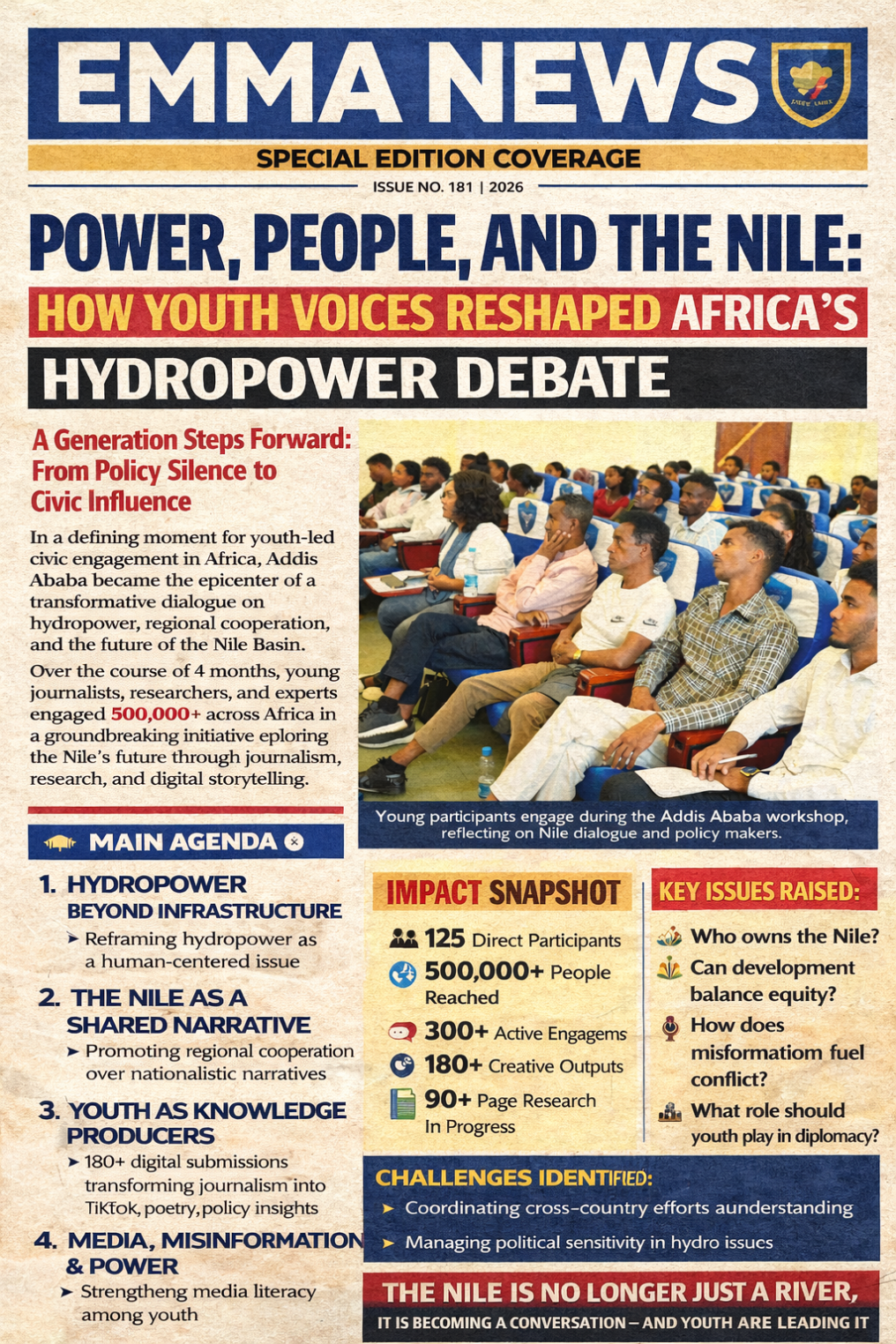
What started as a modest engagement initiative in Addis Ababa soon unfolded into a rare intellectual and civic convergence, one that bridged journalism, research, and digital creativity across borders. Over four months, students, journalists, activists, and scholars from across the Nile Basin did not simply discuss hydropower; they reframed it.
The project, “Hydropower and Youth Voices: Ethiopia’s Water Future,” moved beyond conventional outreach. It became a dynamic space where knowledge was not delivered, but debated, where narratives were not accepted, but interrogated, and where a generation began to redefine its relationship with one of Africa’s most politically charged resources.
At the center of this transformation was Ann Neumann’s reporting, published through the Pulitzer Center on Crisis Reporting. Her work did something rare: it unsettled certainty. By bringing forward the human consequences of hydropower stories of displacement, inequality, and contested futures, it challenged participants to move beyond the familiar language of development and into the more uncomfortable terrain of complexity.
But the real story was not the reporting itself.
It was what happened next.
As the project unfolded through webinars, in-person dialogue, and a surge of digital storytelling, journalism ceased to be a final product. It became a provocation, a starting point for reflection, disagreement, creativity, and, ultimately, transformation.
When a Story Refuses to End
The initiative began with a deceptively simple idea: What if a story does not end when it is published—but begins when it is read?
For many participants, this question marked a turning point.
Neumann’s reporting had already complicated dominant narratives around the Nile. It revealed:
- The everyday realities of communities living in the shadow of geopolitical decisions
- The contradictions embedded in large-scale development projects
- The fragile balance between national ambition and regional coexistence
Yet for a generation raised on a singular narrative of hydropower as progress, these perspectives were both unfamiliar and unsettling.
One participant captured this shift with striking clarity:
“I used to think of the Nile as a source of power. Now I see it as a source of questions.”
That transition from certainty to curiosity became the defining moment of the project.
It was no longer about defending positions or repeating narratives.
It was about rethinking them.
The Spark That Changed the Conversation
For decades, hydropower in Ethiopia, particularly the Grand Ethiopian Renaissance Dam, has been framed as a symbol of resilience and self-determination. It represents a national aspiration to overcome poverty and assert control over natural resources.
But the project introduced a critical tension: What happens when a symbol is examined from multiple perspectives?
Through guided discussions, participants began to unpack the layers beneath the narrative:
- Who benefits from hydropower and who bears the cost?
- Can development be separated from environmental and social consequences?
- How do historical power imbalances shape present-day conflicts?
These were not easy questions. Nor were they meant to be.
They were, instead, the foundation of a deeper intellectual engagement, one that moved beyond slogans and into analysis.
A Generation in Transition
What emerged from this process was not a unified answer, but something far more significant: a shift in how participants approached the issue itself.
Hydropower was no longer seen as:
- purely technical
- purely political
- or purely national
It became a multi-dimensional issue, shaped by:
- human experiences
- environmental realities
- media narratives
- and regional dynamics
And perhaps most importantly, participants began to see themselves within this landscape—not as observers, but as contributors.
By the time the first workshop concluded, the project had already begun to exceed its original scope.
It was no longer just about engaging youth.
It was about activating them.
The story that started as an investigation into hydropower had evolved into something else entirely:
- a platform for dialogue
- a space for critical reflection
- a catalyst for creative expression
And in that transformation lies the true significance of the initiative.
Because what unfolded was not simply a discussion about the Nile.
It was the emergence of a new kind of narrative, one written not by institutions alone, but by a generation willing to question, to create, and to engage.
II. The Webinar Arena: Where Knowledge Collided
The webinar series was not just a sequence of lectures; it was a cross-border intellectual arena.
Experts, scholars, and practitioners from Ethiopia, Sudan, Egypt, Kenya, and beyond convened to unpack hydropower through multiple lenses.
Media, Power, and Narrative Control
Dr. Negesse Belay delivered one of the most striking interventions. His presentation dissected the role of media in shaping hydropower discourse.
“The Nile is not only a river, it is a narrative battlefield,” he argued. “And whoever controls the narrative often controls perception, and sometimes policy.”
His analysis echoed Neumann’s warnings about misinformation and media suppression. But it also went further challenging young participants to interrogate their own assumptions.
This idea resonated deeply with digital contestant Simeneh Emiru, whose work later focused on “information warfare”:
“I realized that the conflict is not just about water, it is about stories. Who tells them. Who believes them.”
Development vs. Sustainability: A Scientific Reality Check
Dr. Ayele Addis introduced a sobering scientific perspective.
“Hydropower is necessary but not innocent,” he said. “Every megawatt comes with ecological consequences. The question is not whether to develop but how.”
His presentation grounded the emotional and political debates in environmental realities:
- Ecosystem disruption
- Climate variability
- Long-term sustainability risks
Participants were forced to confront a difficult truth: development is never neutral.
Geopolitics and the Shadow of History
Dr. Desealeghe Yeshamble shifted the discussion to geopolitics.
He traced the roots of Nile tensions back to colonial-era treaties, arguing:
“The current conflict is not new, it is inherited. But the responsibility to resolve it belongs to this generation.”
This historical framing aligned closely with Neumann’s reporting, reinforcing the idea that hydropower cannot be understood outside of power, history, and inequality.
Regional Voices: Cooperation or Conflict?
The participation of the Nile Basin Initiative added a diplomatic dimension.
Their message was clear:
“Water can divide, but it can also unite. The difference lies in dialogue.”
For many participants, this was the first time they encountered a regional institutional perspective.
III. The Workshop: Where Ideas Became Personal
If the webinars were intellectual, the in-person workshop was emotional and transformative.
Held in Addis Ababa, the workshop brought together 60 young participants from across Ethiopia—including Bahir Dar, Injibara, and Fenote Selam.
The Turning Point: Human Stories
The presentation of Neumann’s story became the emotional core.
Participants listened to accounts of refugees facing discrimination in Cairo—stories that connected water politics to human suffering.
Silence filled the room.
Then came the reflections.
“We celebrate the dam,” one participant said, “but we rarely ask: who pays the price?”
Dialogue as Discovery
Group discussions quickly evolved into deep debates:
- Is development worth displacement?
- Can national pride coexist with regional fairness?
- What is the role of youth in preventing conflict?
The answers were not simple. But the process itself was transformative.
IV. The Digital Contest: Where Knowledge Became Creation
If the workshop changed minds, the digital contest unleashed voices.
Over 180 submissions flooded in videos, poems, graphics, and essays.
But these were not just creative outputs. They were acts of interpretation.
Voices That Stood Out
Hanna Kefale – The Power of Diplomacy
Hanna’s TikTok series reframed the Nile conversation entirely.
“The dam is not the solution, people are,” she declared in one video.
Her work emphasized:
- People-to-people diplomacy
- Youth leadership
- Cultural storytelling
Abraham Hailu – The Power of Narrative
Abraham took a different approach, analytical, historical, and critical.
“The Nile story has been written many times,” he said. “But not always truthfully.”
His work examined:
- Media framing
- National narratives
- International influence
Simeneh Emiru – The Power of Truth
Simeneh’s focus on misinformation struck a chord.
“If we don’t question what we hear,” he warned, “we become part of the conflict.”
V. The Hidden Achievement: Knowledge Transformation
Beyond outputs and numbers, the project achieved something deeper:
It transformed knowledge itself.
From Consumption to Production
Participants moved from:
- Passive readers
to - Active creators
From National to Regional Thinking
Survey data revealed:
- 72% shifted to multi-perspective understanding
- 85% improved knowledge of hydropower complexity
From Silence to Voice
Over 300 active engagements—comments, discussions, submissions—demonstrated a critical shift:
Youth were no longer spectators.
They were participants in the discourse.
VI. The Reach: A Quiet Revolution
Through radio broadcasts, social media, and digital platforms, the project reached over 500,000 people.
But reach alone does not define impact.
Impact lies in transformation.
And transformation was everywhere:
- In the questions asked
- In the stories told
- In the perspectives changed
VII. Challenges That Became Strengths
The journey was not without obstacles:
- Cross-country coordination
- Sensitive political narratives
- Technical challenges in hybrid delivery
Yet these challenges became part of the learning.
As one organizer reflected:
“Dialogue is difficult, but that is exactly why it matters.”
VIII. The Legacy: Beyond the Project
Perhaps the most remarkable outcome is what cannot be easily measured.
A 90+ page research output now documents the insights generated—bridging journalism, academia, and youth voices.
More importantly, a network has emerged:
- Youth committed to dialogue
- Journalists are committed to the truth
- Scholars committed to engagement
IX. Final Reflection: A New Kind of Story
In the end, this project did something extraordinary.
It took a story about hydropower—and turned it into:
- A platform for dialogue
- A catalyst for critical thinking
- A movement of youth engagement
As one participant said:
“The Nile is no longer just a river to me. It is a conversation.”
Conclusion: The Future Flows Forward
In a world where conflicts over water are expected to intensify, this project offers a powerful lesson:
Solutions will not come only from governments or engineers.
They will come from:
- informed citizens
- critical thinkers
- creative storytellers
And above all, from youth, willing to ask difficult questions.
Because in the end, the future of the Nile will not be decided only by dams or treaties.
Voices will shape it.
<strong>RUSSIAN WORLD MEET AFRICAN WORLD: HOW CULTURE, LANGUAGE AND EDUCATION ARE BUILDING A HUMAN BRIDGE</strong>
From Pushkin poetry in Addis Ababa to African celebrating Russian traditions in Moscow, a cultural relationship is being rebuilt one conversation, song and friendship at a time By MESERET ABEBE ABAY, EMMA NEWS (publicmediaet@gmail.com) 05 April , 2026 A Russian poem is read in Addis Ababa. The voice is Ethiopian. The language is Russian. Nearby, […]